A 1.0 kg ball and a 2.0 kg ball are connected by a 1.0-m-long rigid, massless rod. The rod is rotating cw about its center of mass at 20 rpm. What net torque will bring the balls to a halt in 5.0 s?
Ch 12: Rotation of a Rigid Body
Knight Calc5th EditionPhysics for Scientists and EngineersISBN: 9780137344796Not the one you use?Change textbook
Chapter 12, Problem 22
A 4.0-m-long, 500 kg steel beam extends horizontally from the point where it has been bolted to the framework of a new building under construction. A 70 kg construction worker stands at the far end of the beam. What is the magnitude of the torque about the bolt due to the worker and the weight of the beam?
Verified step by step guidance1
Step 1: Understand the concept of torque. Torque is the rotational equivalent of force and is calculated using the formula: , where is the distance from the pivot point, is the force applied, and is the angle between the force and the lever arm. In this problem, the angle is 90 degrees, so .
Step 2: Calculate the torque due to the construction worker. The force exerted by the worker is his weight, which is given by , where is the mass of the worker (70 kg) and is the acceleration due to gravity (approximately 9.8 m/s²). The distance is the length of the beam (4.0 m). Use the formula for torque: .
Step 3: Calculate the torque due to the weight of the beam. The beam's weight acts at its center of gravity, which is located at the midpoint of the beam (2.0 m from the bolt). The force exerted by the beam is its weight, given by , where is the mass of the beam (500 kg) and is the acceleration due to gravity (9.8 m/s²). Use the formula for torque: .
Step 4: Add the torques together. Since both the worker and the beam exert forces that cause rotation in the same direction about the bolt, their torques can be added directly. The total torque is the sum of the torque due to the worker and the torque due to the beam.
Step 5: Ensure units are consistent. Verify that all distances are in meters, masses are in kilograms, and forces are in newtons. This ensures the torque is calculated in newton-meters (N·m).

Verified video answer for a similar problem:
This video solution was recommended by our tutors as helpful for the problem above.
Video duration:
10mWas this helpful?
Key Concepts
Here are the essential concepts you must grasp in order to answer the question correctly.
Torque
Torque is a measure of the rotational force applied to an object around a pivot point. It is calculated as the product of the force applied and the distance from the pivot point to the line of action of the force, expressed as τ = r × F, where τ is torque, r is the distance, and F is the force. In this scenario, both the weight of the beam and the worker's weight create torques about the bolt.
Recommended video:
Guided course
Net Torque & Sign of Torque
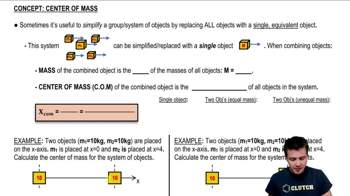
Center of Mass
The center of mass is the point at which the mass of an object is concentrated and can be considered to act. For uniform objects like the steel beam, the center of mass is located at its midpoint. Understanding the center of mass is crucial for calculating the torque due to the beam's weight, as it determines the effective distance from the pivot point to where the weight acts.
Recommended video:
Guided course
Intro to Center of Mass
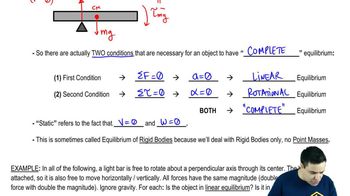
Equilibrium
Equilibrium in physics refers to a state where the sum of forces and the sum of torques acting on an object are zero, resulting in no net motion. In this problem, analyzing the torques created by the worker and the beam's weight about the bolt helps determine if the system is in equilibrium and allows for the calculation of the total torque acting on the beam.
Recommended video:
Guided course
Torque & Equilibrium
Related Practice
Textbook Question
1
views
Textbook Question
In FIGURE EX12.19, for what value of Xaxle will the two forces provide 1.8 Nm of torque about the axle?
1
views
Textbook Question
A 12-cm-diameter DVD has a mass of 21 g. What is the DVD’s moment of inertia for rotation about a perpendicular axis through its center?
1
views
Textbook Question
An object whose moment of inertia is 4.0 kg m2 is rotating with angular velocity 0.25 rad/s. It then experiences the torque shown in FIGURE EX12.25. What is the object's angular velocity at t = 3.0s?
2
views
Textbook Question
An object's moment of inertia is 2.0 kg m2. Its angular velocity is increasing at the rate of 4.0 rad/s per second. What is the net torque on the object?
1
views
Textbook Question
A 12-cm-diameter DVD has a mass of 21 g. What is the DVD's moment of inertia for rotation about a perpendicular axis through the edge of the disk?
2
views