Ch 12: Rotation of a Rigid Body
Knight Calc - Physics for Scientists and Engineers 5th Edition
Knight Calc5th EditionPhysics for Scientists and EngineersISBN: 9780137344796Not the one you use?Change textbook
Chapter 12, Problem 19

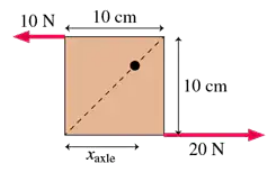
In FIGURE EX12.19, for what value of Xaxle will the two forces provide 1.8 Nm of torque about the axle?

Verified step by step guidance
1
Step 1: Recall the formula for torque: τ = F × r × sin(θ), where F is the force, r is the distance from the axis of rotation to the point of application of the force, and θ is the angle between the force vector and the lever arm.
Step 2: Analyze the diagram. The forces F1 and F2 are applied at different points on the rectangle. F1 is applied horizontally to the left, and F2 is applied horizontally to the right. The axle is located at point A(x_A, y_A). The distances from the axle to the points of application of F1 and F2 need to be determined.
Step 3: For F1, the perpendicular distance to the axle is the vertical distance y_A. For F2, the perpendicular distance to the axle is the horizontal distance x_A. These distances will be used to calculate the torque contributions from each force.
Step 4: Write the torque equation for the system. The total torque about the axle is given as τ_total = τ_F1 + τ_F2. Substitute the values: τ_total = F1 × y_A + F2 × x_A. The total torque is specified as 1.8 Nm.
Step 5: Solve for x_A. Rearrange the equation to isolate x_A: x_A = (τ_total - F1 × y_A) / F2. Substitute the given values for τ_total, F1, y_A, and F2 to find x_A.

Verified video answer for a similar problem:

This video solution was recommended by our tutors as helpful for the problem above.
Video duration:
16m
Was this helpful?

Key Concepts

Here are the essential concepts you must grasp in order to answer the question correctly.

Torque

Torque is a measure of the rotational force applied to an object, calculated as the product of the force and the distance from the pivot point (lever arm). It is expressed in Newton-meters (Nm). The direction of the torque is determined by the direction of the force and the position of the lever arm relative to the pivot.
Recommended video:
Guided course
08:55
Net Torque & Sign of Torque

Lever Arm

The lever arm is the perpendicular distance from the line of action of the force to the axis of rotation. In torque calculations, the lever arm is crucial because it directly influences the amount of torque produced by a given force. A longer lever arm results in greater torque for the same force.
Recommended video:
Guided course
06:58
Ice skater closes her arms

Equilibrium of Forces

In physics, the equilibrium of forces occurs when the sum of all forces acting on an object is zero, resulting in no net force and no acceleration. For torque, this means that the clockwise and counterclockwise torques must balance each other out, allowing for the calculation of unknown forces or distances in a system.
Recommended video: