Ch 18: A Macroscopic Description of Matter
Knight Calc - Physics for Scientists and Engineers 5th Edition
Knight Calc5th EditionPhysics for Scientists and EngineersISBN: 9780137344796Not the one you use?Change textbook
Chapter 18, Problem 18

Common outdoor thermometers are filled with red-colored ethyl alcohol. One thermometer has a 0.40-mm-diameter capillary tube attached to a 9.0-mm-diameter spherical bulb. On a 0°C morning, the column of alcohol stands 30 mm above the bulb. What is the temperature in °C when the column of alcohol stands 130 mm above the bulb? The expansion of the glass is much less than that of the alcohol and can be ignored.

Verified step by step guidance
1
Identify the initial and final heights of the alcohol column above the bulb, which are 30 mm and 130 mm respectively.
Calculate the change in height of the alcohol column, which is the difference between the final and initial heights.
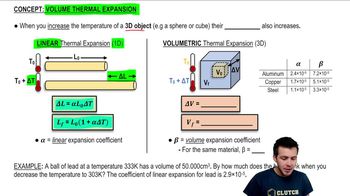
Understand that the change in height of the alcohol column is due to the thermal expansion of the alcohol. The volume expansion of the alcohol can be related to the temperature change using the formula for volume expansion, \(\Delta V = \beta V_0 \Delta T\), where \(\beta\) is the coefficient of volume expansion, \(V_0\) is the initial volume, and \(\Delta T\) is the change in temperature.
Calculate the initial volume of the alcohol in the bulb and the capillary tube. The volume in the bulb can be calculated using the formula for the volume of a sphere, \(V = \frac{4}{3}\pi r^3\), and the volume in the capillary tube can be calculated using the formula for the volume of a cylinder, \(V = \pi r^2 h\).
Using the calculated change in volume and the initial volume, solve for the change in temperature, \(\Delta T\), using the volume expansion formula. Add this change in temperature to the initial temperature to find the final temperature.

Verified video answer for a similar problem:

This video solution was recommended by our tutors as helpful for the problem above.
Video duration:
9m
Was this helpful?

Key Concepts

Here are the essential concepts you must grasp in order to answer the question correctly.

Thermal Expansion

Thermal expansion refers to the increase in volume of a substance as its temperature rises. In the context of thermometers, liquids like ethyl alcohol expand significantly more than the glass of the thermometer itself. This property allows the liquid to rise in the capillary tube, providing a visual indication of temperature changes.
Recommended video:
Guided course
05:21
Volume Thermal Expansion

Capillary Action

Capillary action is the ability of a liquid to flow in narrow spaces without the assistance of external forces. In thermometers, this phenomenon allows the alcohol to rise in the narrow capillary tube when heated. The height of the liquid column is directly related to the temperature, as the liquid expands and moves upward.
Recommended video:
Guided course
08:01
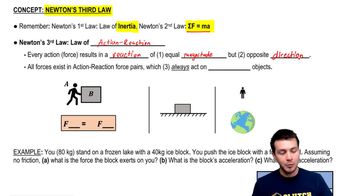
Newton's Third Law & Action-Reaction Pairs

Temperature Scale

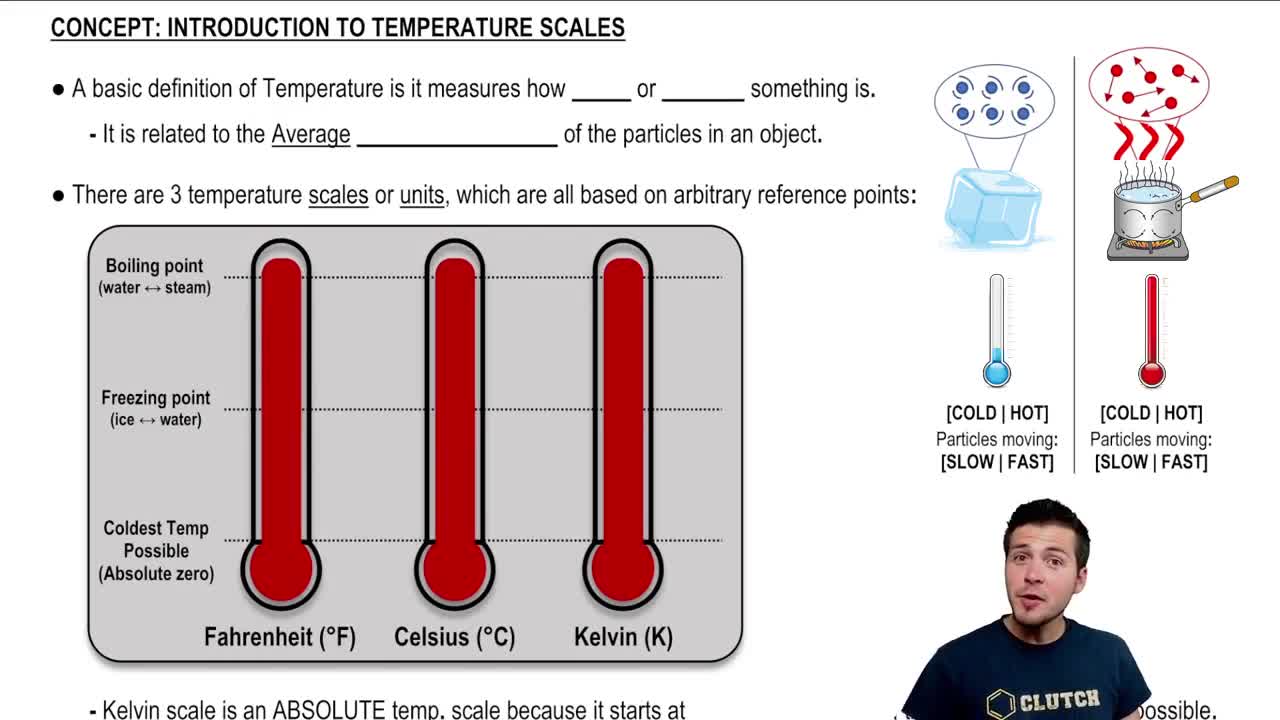
The temperature scale is a system for measuring temperature, commonly using degrees Celsius (°C). In this problem, the relationship between the height of the alcohol column and temperature is linear, allowing for the calculation of temperature based on the change in height. Understanding this relationship is crucial for determining the temperature corresponding to the new height of the alcohol column.
Recommended video:
Guided course
04:54
Introduction To Temperature Scales