Ch. 08 - Conservation of Energy
Giancoli Douglas - Physics for Scientists and Engineers 5th edition
Giancoli Douglas5th editionPhysics for Scientists and EngineersISBN: 9780137488179Not the one you use?Change textbook
Chapter 8, Problem 4a

A 66.5-kg hiker starts at an elevation of 1150 m and climbs to the top of a peak 2660 m high. What is the hiker’s change in potential energy?

Verified step by step guidance
1
Identify the formula for gravitational potential energy, which is given by: U = mgh, where U is the potential energy, m is the mass, g is the acceleration due to gravity, and h is the height.
Determine the change in height, Δh, by subtracting the initial elevation from the final elevation: Δh = hfinal - hinitial. Substitute the given values: Δh = 2660 \(\text{ m}\) - 1150 \(\text{ m}\).
Substitute the hiker's mass, m = 66.5 \(\text{ kg}\), and the standard acceleration due to gravity, g = 9.8 \(\text{ m/s}\)^2, into the formula for gravitational potential energy.
Calculate the change in potential energy, ΔU, using the formula: ΔU = mgΔh. Substitute the values for m, g, and Δh.
Simplify the expression to find the numerical value of the change in potential energy, ensuring the units are consistent and the result is expressed in joules (J).

Verified video answer for a similar problem:

This video solution was recommended by our tutors as helpful for the problem above.
Video duration:
2m
Was this helpful?

Key Concepts

Here are the essential concepts you must grasp in order to answer the question correctly.

Potential Energy

Potential energy is the energy stored in an object due to its position in a gravitational field. It is calculated using the formula PE = mgh, where PE is potential energy, m is mass, g is the acceleration due to gravity (approximately 9.81 m/s² on Earth), and h is the height above a reference point. In this context, the hiker's potential energy changes as they ascend to a higher elevation.
Recommended video:
Guided course
07:24
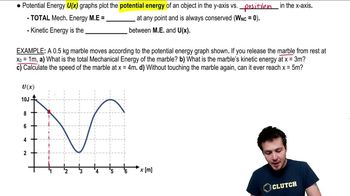
Potential Energy Graphs

Change in Potential Energy

The change in potential energy (ΔPE) is the difference in potential energy between two heights. It can be calculated by finding the potential energy at the final height and subtracting the potential energy at the initial height. This change reflects the work done against gravity as the hiker climbs from a lower elevation to a higher one.
Recommended video:
Guided course
06:35
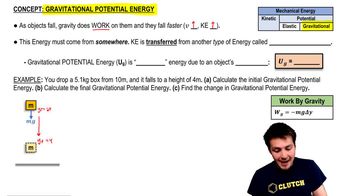
Gravitational Potential Energy

Gravitational Force

Gravitational force is the attractive force that acts between two masses, such as the Earth and the hiker. It is responsible for the weight of the hiker and influences the potential energy calculations. The force can be considered constant near the Earth's surface, allowing for straightforward calculations of potential energy changes as the hiker moves vertically.
Recommended video:
Guided course
05:41
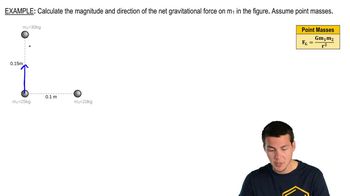
Gravitational Forces in 2D