

Ch. 08 - Conservation of Energy
Giancoli Douglas - Physics for Scientists and Engineers 5th edition
Giancoli Douglas5th editionPhysics for Scientists and EngineersISBN: 9780137488179Not the one you use?Change textbook
Chapter 8, Problem 1

By how much does the gravitational potential energy of a 58-kg pole vaulter change if her center of mass rises 4.0 m during the jump?

Verified step by step guidance
1
Identify the formula for gravitational potential energy, which is given by: U = mgh, where U is the gravitational potential energy, m is the mass, g is the acceleration due to gravity, and h is the height.
Determine the change in gravitational potential energy, which is given by the formula: ΔU = mgΔh, where Δh is the change in height.
Substitute the given values into the formula: m = 58 kg, g = 9.8 m/s² (standard acceleration due to gravity), and Δh = 4.0 m.
Perform the multiplication: ΔU = 58 × 9.8 × 4.0. This will give the change in gravitational potential energy in joules (J).
Conclude that the result represents the increase in gravitational potential energy as the pole vaulter's center of mass rises by 4.0 m.

Verified video answer for a similar problem:

This video solution was recommended by our tutors as helpful for the problem above.
Video duration:
2m
Was this helpful?

Key Concepts

Here are the essential concepts you must grasp in order to answer the question correctly.

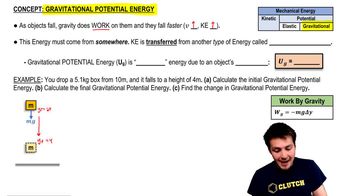
Gravitational Potential Energy

Gravitational potential energy (GPE) is the energy an object possesses due to its position in a gravitational field. It is calculated using the formula GPE = mgh, where m is the mass of the object, g is the acceleration due to gravity (approximately 9.81 m/s² on Earth), and h is the height above a reference point. In this context, the pole vaulter's change in height directly affects her GPE.
Recommended video:
Guided course
06:35
Gravitational Potential Energy

Mass

Mass is a measure of the amount of matter in an object, typically measured in kilograms (kg). In the context of the question, the mass of the pole vaulter (58 kg) is a crucial factor in determining the change in gravitational potential energy as she rises. The greater the mass, the more gravitational potential energy is associated with a given height.
Recommended video:
Guided course
20:32
Mass Spectrometers

Height Change

Height change refers to the vertical distance an object moves in a gravitational field. In this scenario, the pole vaulter's center of mass rises by 4.0 m, which is essential for calculating the change in gravitational potential energy. The height change directly influences the GPE, as a higher elevation results in greater potential energy.
Recommended video:
Guided course
06:50
Specific Heat & Temperature Changes