Ch. 08 - Conservation of Energy
Giancoli Douglas - Physics for Scientists and Engineers 5th edition
Giancoli Douglas5th editionPhysics for Scientists and EngineersISBN: 9780137488179Not the one you use?Change textbook
Chapter 8, Problem 11

A novice skier, starting from rest, slides down an icy frictionless 8.0° incline whose vertical height is 115 m. How fast is she going when she reaches the bottom?

Verified step by step guidance
1
Step 1: Identify the given values and the goal of the problem. The skier starts from rest, so the initial velocity \( v_0 \) is 0. The incline angle is \( \theta = 8.0^\circ \), and the vertical height \( h \) is 115 m. The goal is to find the final velocity \( v_f \) at the bottom of the incline.
Step 2: Use the principle of conservation of energy. Since the incline is frictionless, the skier's potential energy at the top is completely converted into kinetic energy at the bottom. The formula for conservation of energy is \( m g h = \frac{1}{2} m v_f^2 \), where \( m \) is the mass of the skier, \( g \) is the acceleration due to gravity (\( 9.8 \ \text{m/s}^2 \)), \( h \) is the vertical height, and \( v_f \) is the final velocity.
Step 3: Simplify the equation by canceling out the mass \( m \), since it appears on both sides of the equation. This gives \( g h = \frac{1}{2} v_f^2 \). Rearrange the equation to solve for \( v_f \): \( v_f = \sqrt{2 g h} \).
Step 4: Substitute the known values into the equation. Use \( g = 9.8 \ \text{m/s}^2 \) and \( h = 115 \ \text{m} \). The equation becomes \( v_f = \sqrt{2 \cdot 9.8 \cdot 115} \).
Step 5: Perform the calculation to find \( v_f \). This will give the skier's final velocity at the bottom of the incline. Ensure the units are consistent throughout the calculation.

Verified video answer for a similar problem:

This video solution was recommended by our tutors as helpful for the problem above.
Video duration:
7m
Was this helpful?

Key Concepts

Here are the essential concepts you must grasp in order to answer the question correctly.

Conservation of Energy

The principle of conservation of energy states that energy cannot be created or destroyed, only transformed from one form to another. In this scenario, the skier's potential energy at the top of the incline is converted into kinetic energy as she slides down. This relationship allows us to calculate the skier's speed at the bottom by equating the initial potential energy to the final kinetic energy.
Recommended video:
Guided course
06:24
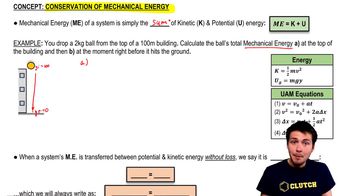
Conservation Of Mechanical Energy

Potential Energy

Potential energy is the energy stored in an object due to its position in a gravitational field. For the skier, the potential energy at the top of the incline can be calculated using the formula PE = mgh, where m is mass, g is the acceleration due to gravity, and h is the height. This energy is what drives the skier's motion down the slope.
Recommended video:
Guided course
07:24
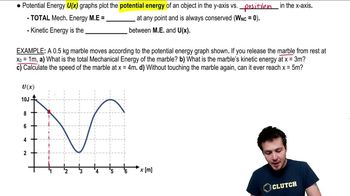
Potential Energy Graphs

Kinetic Energy

Kinetic energy is the energy of an object in motion, defined by the formula KE = 0.5mv², where m is mass and v is velocity. As the skier descends the incline, her potential energy is converted into kinetic energy, which determines her speed at the bottom of the slope. Understanding this relationship is crucial for solving the problem.
Recommended video:
Guided course
06:07
Intro to Rotational Kinetic Energy
Related Practice
Textbook Question

A vertical spring (ignore its mass), whose spring constant is 875 N/m, is attached to a table and is compressed down by 0.220 m. What upward speed can it give to a 0.380-kg ball when released?

1
views
Textbook Question

A particle is constrained to move in one dimension along the x axis and is acted upon by a force given by F(x)\(\overrightarrow{F}\]\left\)(x\(\right\)) = - (k/x³) î, where k is a constant with units appropriate to the SI system. Find the potential energy function U(x), if U is arbitrarily defined to be zero at x = 2.0m, so that U (2.0m) = 0.

2
views
Textbook Question

You drop a basketball from a height of 5.0 m, which rebounds to a new height of 3.0 m. How much energy is lost to nonconservative forces? Give your answer as percentage of the initial energy.

2
views
Textbook Question

Two masses are connected by a string as shown in Fig. 8–35. Mass mA = 3.5 kg rests on a frictionless inclined plane, while mB = 5.0 kg is initially held at a height of h = 0.75 m above the floor. Use conservation of energy to find the velocity of the masses just before mB hits the floor. You should get the same answer as in part (b).

2
views
Textbook Question

A 66.5-kg hiker starts at an elevation of 1150 m and climbs to the top of a peak 2660 m high. What is the hiker’s change in potential energy?

2
views
Textbook Question

A 1400-kg car moving on a horizontal surface has speed v = 85 km/h when it strikes a horizontal coiled spring and is brought to rest in a distance of 2.2 m. What is the spring constant of the spring? Ignore any thermal energy produced in the collision.

1
views