
Textbook Question
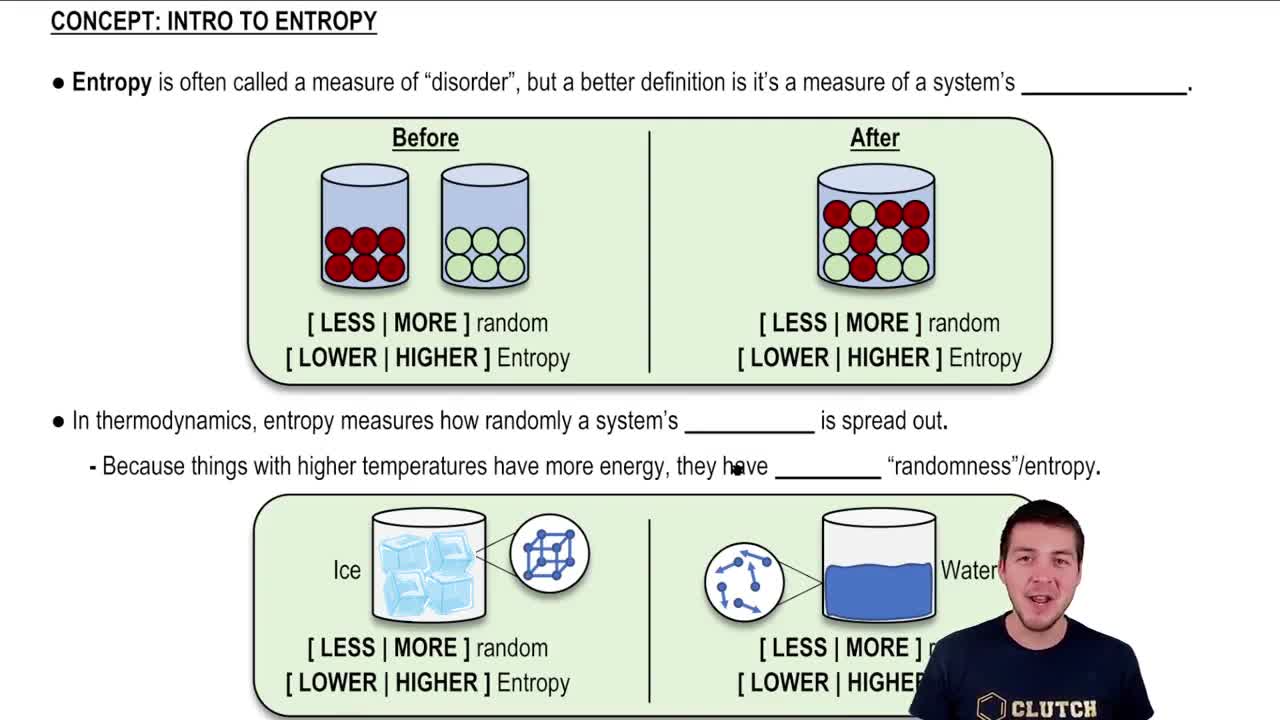
Suppose that you repeatedly shake six coins in your hand and drop them on the floor. Construct a table showing the number of microstates that correspond to each macrostate. What is the probability of obtaining six heads?
2
views

 Verified step by step guidance
 07:50
07:50
 05:21
05:21 06:24
06:24Suppose that you repeatedly shake six coins in your hand and drop them on the floor. Construct a table showing the number of microstates that correspond to each macrostate. What is the probability of obtaining six heads?
Use Eq. 20–14 to determine the entropy of each of the five macrostates listed in Table 20–1 on page 595.
Why would you expect the total entropy change in a Carnot cycle to be zero? Do a calculation to show that it is zero.
If 0.45 kg of water at 100°C is changed by a reversible process to steam at 100°C, determine the change in entropy of the water, the surroundings, and the universe as a whole. How would your answers differ if the process were irreversible?
Why would you expect the total entropy change in a Carnot cycle to be zero?
Suppose that you repeatedly shake six coins in your hand and drop them on the floor. Construct a table showing the number of microstates that correspond to each macrostate. What is the probability of obtaining three heads and three tails?