
Ch 09: Work and Kinetic Energy
Knight Calc - Physics for Scientists and Engineers 5th Edition
Knight Calc5th EditionPhysics for Scientists and EngineersISBN: 9780137344796Not the one you use?Change textbook
Chapter 9, Problem 69c

Finish the solution of the problem.
T(1500kg)(9.8m/s2)=(1500kg)(1.0m/s2)T-(1500\,\(\text{kg}\))(9.8\,\(\text{m/s}\)^2)=(1500\,\(\text{kg}\))\(\left\)(1.0\,\(\text{m/s}\)^2\(\right\))
P=T(2.0m/s)P=T(2.0\,\(\text{m/s}\))

Verified step by step guidance
1
Identify the forces acting on the object. The equation T - (1500 \; \(\text{kg}\))(9.8 \; \(\text{m/s}\)^2) = (1500 \; \(\text{kg}\))(1.0 \; \(\text{m/s}\)^2) represents the net force acting on the object, where T is the tension in the rope, (1500 \; \(\text{kg}\))(9.8 \; \(\text{m/s}\)^2) is the gravitational force, and (1500 \; \(\text{kg}\))(1.0 \; \(\text{m/s}\)^2) is the net force due to acceleration.
Rearrange the equation to solve for the tension T. Add the gravitational force term to both sides: \( T = (1500 \; \text{kg})(9.8 \; \text{m/s}^2) + (1500 \; \text{kg})(1.0 \; \text{m/s}^2) \).
Substitute the values into the equation to calculate T. This will give you the total tension in the rope.
Next, use the equation for power: \( P = T \cdot v \), where \( v = 2.0 \; \text{m/s} \) is the velocity. Substitute the value of T from the previous step into this equation.
Simplify the expression for power \( P \) by multiplying the tension \( T \) with the velocity \( v \). This will give you the power output in watts.

Verified video answer for a similar problem:

This video solution was recommended by our tutors as helpful for the problem above.
Was this helpful?

Key Concepts

Here are the essential concepts you must grasp in order to answer the question correctly.

Tension in a Rope

Tension is the force transmitted through a rope, string, or cable when it is pulled tight by forces acting from opposite ends. In this context, the tension (T) is calculated based on the weight of the object (1500 kg) and the acceleration due to gravity (9.8 m/s²), which helps determine the net force acting on the system.
Recommended video:
Guided course
06:34
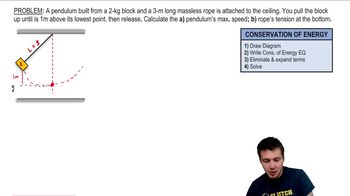
Calculating Tension in a Pendulum with Energy Conservation

Newton's Second Law of Motion

Newton's Second Law states that the acceleration of an object is directly proportional to the net force acting on it and inversely proportional to its mass. This principle is crucial for solving the problem, as it allows us to relate the forces acting on the 1500 kg mass to its acceleration (1.0 m/s²) and calculate the resulting tension in the rope.
Recommended video:
Guided course
06:54
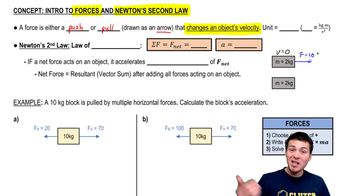
Intro to Forces & Newton's Second Law

Power Calculation

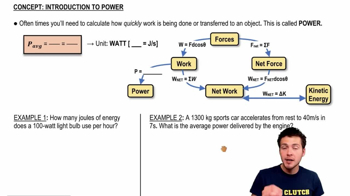
Power is defined as the rate at which work is done or energy is transferred over time. In this problem, power (P) can be calculated using the formula P = T * v, where T is the tension and v is the velocity (2.0 m/s). Understanding how to compute power is essential for finishing the solution and interpreting the physical significance of the forces involved.
Recommended video:
Related Practice
Textbook Question

A 12 kg weather rocket generates a thrust of 200 N. The rocket, pointing upward, is clamped to the top of a vertical spring. The bottom of the spring, whose spring constant is 550 N/m, is anchored to the ground. Initially, before the engine is ignited, the rocket sits at rest on top of the spring. How much is the spring compressed?

2
views
Textbook Question

Astronomers using a 2.0-m-diameter telescope observe a distant supernova - an exploding star. The telescope's detector records 9.1 x 10⁻¹¹ J of light energy during the first 10 s. It's known that this type of supernova has a visible-light power output of 5.0 x 1037 W for the first 10 s of the explosion. How distant is the supernova? Give your answer in light years, where one light year is the distance light travels in one year. The speed of light is 3.0 x 10⁸ m/s.

1
views
Textbook Question

A gardener pushes a 12 kg lawnmower whose handle is tilted up 37° above horizontal. The lawnmower's coefficient of rolling friction is 0.15. How much power does the gardener have to supply to push the lawnmower at a constant speed of 1.2 m/s? Assume his push is parallel to the handle.

2
views
Textbook Question

A 12 kg weather rocket generates a thrust of 200 N. The rocket, pointing upward, is clamped to the top of a vertical spring. The bottom of the spring, whose spring constant is 550 N/m, is anchored to the ground. After the engine is ignited, what is the rocket’s speed when the spring has stretched 40 cm?

1
views
Textbook Question

Write a realistic problem for which this is the correct equation(s).

T(1500kg)(9.8m/s2)=(1500kg)(1.0m/s2)T-(1500\,\(\text{kg}\))(9.8\,\(\text{m/s}\)^2)=(1500\,\(\text{kg}\))\(\left\)(1.0\,\(\text{m/s}\)^2\(\right\))

P=T(2.0m/s)P=T(2.0\,\(\text{m/s}\))

2
views
Textbook Question

Draw a pictorial representation.

T(1500kg)(9.8m/s2)=(1500kg)(1.0m/s2)T-(1500\,\(\text{kg}\))(9.8\,\(\text{m/s}\)^2)=(1500\,\(\text{kg}\))\(\left\)(1.0\,\(\text{m/s}\)^2\(\right\))

P=T(2.0m/s)P=T(2.0\,\(\text{m/s}\))