Ch. 19 - Heat and the First Law of Thermodynamics
Giancoli Douglas - Physics for Scientists and Engineers 5th edition
Giancoli Douglas5th editionPhysics for Scientists and EngineersISBN: 9780137488179Not the one you use?Change textbook
Chapter 19, Problem 25b

High-altitude mountain climbers do not eat snow, but always melt it first with a stove. To see why, calculate the energy absorbed from your body if you melt 1.0 kg of -15°C snow using a stove and drink the resulting 1.0 kg of water at 2°C, which your body has to warm to 37°C.

Verified step by step guidance
1
Determine the energy required to warm the snow from -15°C to 0°C. Use the formula for heat transfer: Q=mcΔT, where m is the mass of the snow (1.0 kg), c is the specific heat capacity of ice (approximately 2,100 J/(kg·°C)), and ΔT is the temperature change (15°C).
Calculate the energy required to melt the snow at 0°C into water. Use the formula: Q=mL, where m is the mass of the snow (1.0 kg) and L is the latent heat of fusion for water (334,000 J/kg).
Determine the energy required to warm the resulting water from 0°C to 2°C. Use the formula: Q=mcΔT, where m is the mass of the water (1.0 kg), c is the specific heat capacity of water (4,186 J/(kg·°C)), and ΔT is the temperature change (2°C).
Calculate the energy required to warm the water from 2°C to 37°C. Again, use the formula: Q=mcΔT, where m is the mass of the water (1.0 kg), c is the specific heat capacity of water (4,186 J/(kg·°C)), and ΔT is the temperature change (35°C).
Add all the calculated energy values from the previous steps to find the total energy absorbed from your body to melt the snow and warm the water to 37°C.

Verified video answer for a similar problem:

This video solution was recommended by our tutors as helpful for the problem above.
Video duration:
12m
Was this helpful?

Key Concepts

Here are the essential concepts you must grasp in order to answer the question correctly.

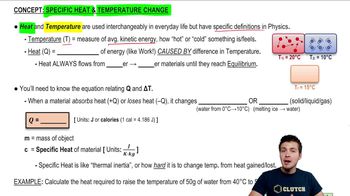
Specific Heat Capacity

Specific heat capacity is the amount of heat energy required to raise the temperature of a unit mass of a substance by one degree Celsius. In this scenario, it is crucial for calculating the energy needed to warm the water from 2°C to body temperature (37°C). The specific heat capacity of water is approximately 4.18 J/g°C, which means it takes a significant amount of energy to change its temperature.
Recommended video:
Guided course
06:50
Specific Heat & Temperature Changes

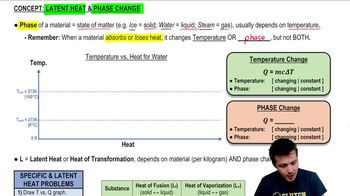
Latent Heat of Fusion

Latent heat of fusion is the amount of energy required to change a substance from solid to liquid at its melting point without changing its temperature. For snow, this energy must be calculated to determine how much heat is absorbed from the body when melting the snow at -15°C into water at 0°C. The latent heat of fusion for ice is about 334 J/g, which is essential for understanding the energy dynamics in this process.
Recommended video:
Guided course
10:40
Latent Heat & Phase Changes

Energy Conservation

The principle of energy conservation states that energy cannot be created or destroyed, only transformed from one form to another. In this context, the energy absorbed from the body when melting snow and warming the resulting water must be accounted for. This principle helps in calculating the total energy expenditure of the climber, as the body loses heat to the melting snow and warming water, impacting their overall energy balance.
Recommended video:
Guided course
06:24
Conservation Of Mechanical Energy