
Ch. 19 - Heat and the First Law of Thermodynamics
Giancoli Douglas - Physics for Scientists and Engineers 5th edition
Giancoli Douglas5th editionPhysics for Scientists and EngineersISBN: 9780137488179Not the one you use?Change textbook
Chapter 19, Problem 20

If 3.40 x 10⁵ J of energy is supplied to a container of liquid oxygen at -183° C , how much oxygen can evaporate?

Verified step by step guidance
1
Determine the latent heat of vaporization (L) for liquid oxygen. This is a material-specific property that represents the amount of energy required to convert 1 kg of liquid oxygen to gas at its boiling point without changing its temperature. For liquid oxygen, L is approximately 213 kJ/kg.
Convert the given energy supplied (Q = 3.40 × 10⁵ J) into kilojoules for consistency with the latent heat value. Use the conversion factor: 1 kJ = 1000 J.
Use the formula for the energy required for phase change: Q = m × L, where Q is the energy supplied, m is the mass of the liquid oxygen that evaporates, and L is the latent heat of vaporization. Rearrange the formula to solve for m: m = Q / L.
Substitute the values of Q (in kJ) and L (213 kJ/kg) into the formula to calculate the mass of oxygen that can evaporate.
Ensure the units are consistent throughout the calculation and interpret the result to determine the mass of oxygen that evaporates in kilograms.

Verified video answer for a similar problem:

This video solution was recommended by our tutors as helpful for the problem above.
Video duration:
2m
Was this helpful?

Key Concepts

Here are the essential concepts you must grasp in order to answer the question correctly.

Latent Heat of Vaporization

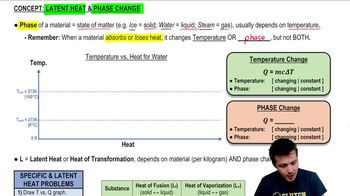
Latent heat of vaporization is the amount of energy required to convert a unit mass of a substance from liquid to gas at constant temperature and pressure. For liquid oxygen, this value is crucial for determining how much energy is needed to evaporate a specific mass of the liquid. Understanding this concept allows us to calculate the mass of oxygen that can evaporate when a certain amount of energy is supplied.
Recommended video:
Guided course
10:40
Latent Heat & Phase Changes

Specific Heat Capacity

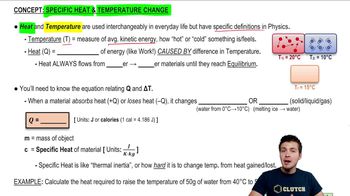
Specific heat capacity is the amount of heat required to raise the temperature of a unit mass of a substance by one degree Celsius. While this concept primarily applies to heating a substance, it is important in the context of phase changes, as it helps to understand how energy is distributed in a system. In this scenario, it is essential to know how much energy is used to raise the temperature of liquid oxygen before it begins to evaporate.
Recommended video:
Guided course
06:50
Specific Heat & Temperature Changes

Phase Change

A phase change refers to the transition of a substance from one state of matter to another, such as from liquid to gas. During this process, the temperature of the substance remains constant while energy is absorbed or released. In the case of liquid oxygen, understanding the phase change is vital for calculating how much energy is needed for evaporation, as it directly relates to the latent heat of vaporization.
Recommended video:
Guided course
10:40
Latent Heat & Phase Changes