
Ch. 19 - Heat and the First Law of Thermodynamics
Giancoli Douglas - Physics for Scientists and Engineers 5th edition
Giancoli Douglas5th editionPhysics for Scientists and EngineersISBN: 9780137488179Not the one you use?Change textbook
Chapter 19, Problem 19

A 0.095-kg aluminum sphere is dropped from the roof of a 55-m-high building. If 65% of the thermal energy produced when it hits the ground is absorbed by the sphere, what is its temperature increase?

Verified step by step guidance
1
Determine the gravitational potential energy of the aluminum sphere before it is dropped. Use the formula: Epg=mgh, where m is the mass of the sphere (0.095 kg), g is the acceleration due to gravity (9.8 m/s²), and h is the height of the building (55 m).
Calculate the total thermal energy produced when the sphere hits the ground. This is equal to the gravitational potential energy calculated in step 1, as all the potential energy is converted into thermal energy upon impact.
Determine the portion of thermal energy absorbed by the sphere. Since 65% of the thermal energy is absorbed, multiply the total thermal energy by 0.65.
Relate the absorbed thermal energy to the temperature increase of the aluminum sphere using the formula: Q=mcΔT, where Q is the absorbed thermal energy, m is the mass of the sphere, c is the specific heat capacity of aluminum (900 J/(kg·°C)), and ΔT is the temperature increase.
Rearrange the formula from step 4 to solve for the temperature increase: ΔT=Qmc. Substitute the values for Q, m, and c to find the temperature increase.

Verified video answer for a similar problem:

This video solution was recommended by our tutors as helpful for the problem above.
Video duration:
4m
Was this helpful?

Key Concepts

Here are the essential concepts you must grasp in order to answer the question correctly.

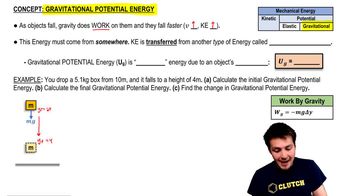
Gravitational Potential Energy

Gravitational potential energy (GPE) is the energy an object possesses due to its height above the ground. It is calculated using the formula GPE = mgh, where m is mass, g is the acceleration due to gravity (approximately 9.81 m/s²), and h is the height. In this scenario, the aluminum sphere's GPE will convert to kinetic energy as it falls, and upon impact, some of this energy will be transformed into thermal energy.
Recommended video:
Guided course
06:35
Gravitational Potential Energy

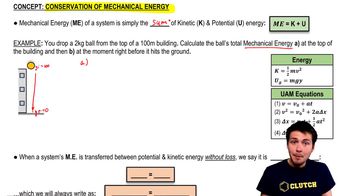
Energy Conservation

The principle of energy conservation states that energy cannot be created or destroyed, only transformed from one form to another. In this case, the gravitational potential energy of the sphere is converted into kinetic energy as it falls, and upon hitting the ground, a portion of that energy is converted into thermal energy, which raises the temperature of the sphere.
Recommended video:
Guided course
06:24
Conservation Of Mechanical Energy

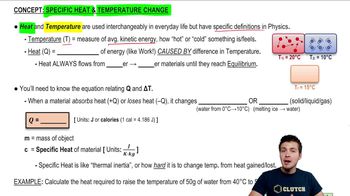
Specific Heat Capacity

Specific heat capacity is the amount of heat energy required to raise the temperature of a unit mass of a substance by one degree Celsius. For aluminum, this value is approximately 900 J/(kg·°C). To find the temperature increase of the sphere after absorbing thermal energy, the formula ΔT = Q/(mc) is used, where ΔT is the temperature change, Q is the heat absorbed, m is the mass, and c is the specific heat capacity.
Recommended video:
Guided course
06:50
Specific Heat & Temperature Changes