Ch. 19 - Heat and the First Law of Thermodynamics
Giancoli Douglas - Physics for Scientists and Engineers 5th edition
Giancoli Douglas5th editionPhysics for Scientists and EngineersISBN: 9780137488179Not the one you use?Change textbook
Chapter 19, Problem 28

Determine the latent heat of fusion of mercury using the following calorimeter data: 1.00 kg of solid Hg at its melting point of −39.0°C is placed in a 0.620-kg aluminum calorimeter with 0.400 kg of water at 12.80°C; the resulting equilibrium temperature is 5.06°C.

Verified step by step guidance
1
Identify the principle of conservation of energy: The heat lost by the water and the aluminum calorimeter is equal to the heat gained by the mercury as it melts and warms to the equilibrium temperature.
Write the heat transfer equations for each component: (1) Heat lost by water: \( Q_{\text{water}} = m_{\text{water}} c_{\text{water}} (T_{\text{initial, water}} - T_{\text{final}}) \), (2) Heat lost by aluminum calorimeter: \( Q_{\text{calorimeter}} = m_{\text{calorimeter}} c_{\text{aluminum}} (T_{\text{initial, calorimeter}} - T_{\text{final}}) \), (3) Heat gained by mercury: \( Q_{\text{mercury}} = m_{\text{Hg}} L_f + m_{\text{Hg}} c_{\text{Hg}} (T_{\text{final}} - T_{\text{melting, Hg}}) \).
Substitute the known values into the equations: \( m_{\text{water}} = 0.400 \ \text{kg}, \ c_{\text{water}} = 4186 \ \text{J/kg·°C}, \ T_{\text{initial, water}} = 12.80 \ \text{°C}, \ T_{\text{final}} = 5.06 \ \text{°C} \); \( m_{\text{calorimeter}} = 0.620 \ \text{kg}, \ c_{\text{aluminum}} = 900 \ \text{J/kg·°C}, \ T_{\text{initial, calorimeter}} = 12.80 \ \text{°C}, \ T_{\text{final}} = 5.06 \ \text{°C} \); \( m_{\text{Hg}} = 1.00 \ \text{kg}, \ T_{\text{melting, Hg}} = -39.0 \ \text{°C}, \ c_{\text{Hg}} = 140 \ \text{J/kg·°C} \).
Set up the energy balance equation: \( Q_{\text{water}} + Q_{\text{calorimeter}} = Q_{\text{mercury}} \). Expand this equation using the heat transfer expressions: \( m_{\text{water}} c_{\text{water}} (T_{\text{initial, water}} - T_{\text{final}}) + m_{\text{calorimeter}} c_{\text{aluminum}} (T_{\text{initial, calorimeter}} - T_{\text{final}}) = m_{\text{Hg}} L_f + m_{\text{Hg}} c_{\text{Hg}} (T_{\text{final}} - T_{\text{melting, Hg}}) \).
Solve for the latent heat of fusion \( L_f \) of mercury: Rearrange the equation to isolate \( L_f \): \( L_f = \frac{[m_{\text{water}} c_{\text{water}} (T_{\text{initial, water}} - T_{\text{final}}) + m_{\text{calorimeter}} c_{\text{aluminum}} (T_{\text{initial, calorimeter}} - T_{\text{final}}) - m_{\text{Hg}} c_{\text{Hg}} (T_{\text{final}} - T_{\text{melting, Hg}})]}{m_{\text{Hg}}} \). Substitute the known values and simplify to find \( L_f \).

Verified video answer for a similar problem:

This video solution was recommended by our tutors as helpful for the problem above.
Video duration:
8m
Was this helpful?

Key Concepts

Here are the essential concepts you must grasp in order to answer the question correctly.

Latent Heat

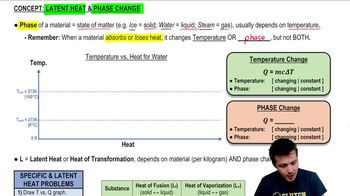
Latent heat is the amount of heat energy required to change a substance from one phase to another without changing its temperature. In the case of fusion, it refers to the energy needed to convert a solid into a liquid at its melting point. This concept is crucial for understanding how energy is transferred during phase changes, such as when solid mercury melts.
Recommended video:
Guided course
10:40
Latent Heat & Phase Changes

Calorimetry

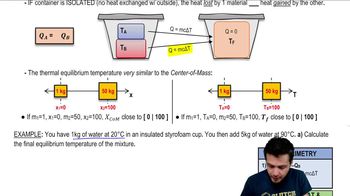
Calorimetry is the science of measuring the heat of chemical reactions or physical changes. In this context, it involves calculating the heat exchanged between the solid mercury, the aluminum calorimeter, and the water to determine the latent heat of fusion. Understanding calorimetry principles is essential for analyzing thermal equilibrium and energy conservation in the system.
Recommended video:
Guided course
06:53
Solving Calorimetry Problems

Thermal Equilibrium

Thermal equilibrium occurs when two or more bodies in contact with each other reach the same temperature, resulting in no net heat flow between them. In this problem, the final equilibrium temperature of 5.06°C indicates that heat has been exchanged among the solid mercury, water, and the calorimeter until they all reached this common temperature. This concept is fundamental for applying the principles of energy conservation in calorimetry.
Recommended video:
Guided course
05:21
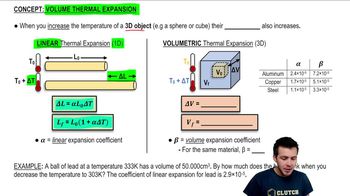
Volume Thermal Expansion