Ch 10: Interactions and Potential Energy
Knight Calc - Physics for Scientists and Engineers 5th Edition
Knight Calc5th EditionPhysics for Scientists and EngineersISBN: 9780137344796Not the one you use?Change textbook
Chapter 10, Problem 29

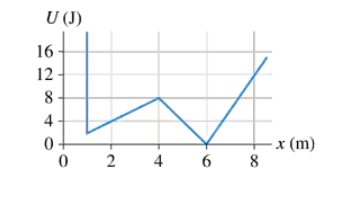
In FIGURE EX10.28, what is the maximum speed a 200 g particle could have at x = 2.0 m and never reach x = 6.0 m?

Verified step by step guidance
1
Step 1: Analyze the graph provided. The graph shows the potential energy U(x) as a function of position x. At x = 2.0 m, U(x) = 0 J, and at x = 6.0 m, U(x) = 4 J. The particle's total mechanical energy must be less than or equal to 4 J to ensure it does not reach x = 6.0 m.
Step 2: Use the principle of conservation of mechanical energy. The total mechanical energy E is the sum of the kinetic energy K and potential energy U. At x = 2.0 m, the potential energy U is 0 J, so the total energy E is equal to the kinetic energy K at this position.
Step 3: Write the expression for kinetic energy K: \( K = \frac{1}{2} m v^2 \), where m is the mass of the particle and v is its speed. The mass of the particle is given as 200 g, which should be converted to kilograms: \( m = 0.2 \, \text{kg} \).
Step 4: Set the total energy E equal to the maximum allowable energy (4 J) to ensure the particle does not reach x = 6.0 m. Solve for the maximum speed v using \( E = \frac{1}{2} m v^2 \). Rearrange the equation to find \( v = \sqrt{\frac{2E}{m}} \).
Step 5: Substitute the values for E (4 J) and m (0.2 kg) into the equation \( v = \sqrt{\frac{2E}{m}} \). This will give the maximum speed the particle can have at x = 2.0 m without reaching x = 6.0 m.

Verified video answer for a similar problem:

This video solution was recommended by our tutors as helpful for the problem above.
Video duration:
4m
Was this helpful?

Key Concepts

Here are the essential concepts you must grasp in order to answer the question correctly.

Potential Energy (U)

Potential energy is the energy stored in an object due to its position in a force field, such as gravitational or elastic fields. In the context of the graph, it represents the energy of the particle at various positions along the x-axis. The height of the curve indicates the potential energy at each position, which influences the particle's ability to move to different locations.
Recommended video:
Guided course
06:35
Gravitational Potential Energy

Conservation of Energy

The principle of conservation of energy states that the total energy in a closed system remains constant. For the particle in the problem, the sum of its kinetic energy and potential energy must equal a constant value. This means that as the particle moves, any change in potential energy will result in a corresponding change in kinetic energy, affecting its speed at different positions.
Recommended video:
Guided course
06:24
Conservation Of Mechanical Energy

Kinetic Energy (KE)

Kinetic energy is the energy of an object due to its motion, calculated using the formula KE = 1/2 mv², where m is mass and v is velocity. In this problem, the maximum speed of the particle at x = 2.0 m can be determined by considering the potential energy at that point and ensuring that the particle has enough kinetic energy to not reach x = 6.0 m, where the potential energy is higher.
Recommended video:
Guided course
06:07
Intro to Rotational Kinetic Energy