
Ch 17: Superposition
Knight Calc - Physics for Scientists and Engineers 5th Edition
Knight Calc5th EditionPhysics for Scientists and EngineersISBN: 9780137344796Not the one you use?Change textbook
Chapter 17, Problem 73b

A flutist assembles her flute in a room where the speed of sound is 342 m/s. When she plays the note A, it is in perfect tune with a 440 Hz tuning fork. After a few minutes, the air inside her flute has warmed to where the speed of sound is 346 m/s. How far does she need to extend the 'tuning joint' of her flute to be in tune with the tuning fork?

Verified step by step guidance
1
Determine the wavelength of the sound wave when the flute is in tune with the tuning fork at the initial speed of sound (342 m/s). Use the formula for wavelength: λ=vf, where v is the speed of sound and f is the frequency.
Calculate the new wavelength of the sound wave when the speed of sound increases to 346 m/s, using the same formula: λ'=v'f, where v' is the new speed of sound.
Recognize that the length of the flute corresponds to half the wavelength of the sound wave for the fundamental frequency. Therefore, the length of the flute when in tune is L=λ2 initially and L'=λ'2 after the air warms.
Find the difference in the flute's length required to stay in tune by calculating ΔL=L'-L. Substitute the expressions for L and L' in terms of the wavelengths.
Simplify the expression for ΔL to find the required extension of the tuning joint. This will give the distance the flutist needs to extend the flute to match the tuning fork's frequency.

Verified video answer for a similar problem:

This video solution was recommended by our tutors as helpful for the problem above.
Video duration:
3m
Was this helpful?

Key Concepts

Here are the essential concepts you must grasp in order to answer the question correctly.

Speed of Sound

The speed of sound is the rate at which sound waves propagate through a medium, such as air. It varies with temperature, humidity, and pressure. In this scenario, the speed of sound increases from 342 m/s to 346 m/s as the air inside the flute warms, affecting the pitch of the sound produced.
Recommended video:
Guided course
05:17
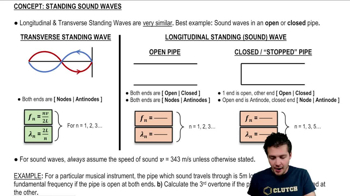
Standing Sound Waves

Frequency and Wavelength

Frequency is the number of oscillations or cycles of a wave per second, measured in Hertz (Hz). The wavelength is the distance between successive crests of a wave. The relationship between speed, frequency, and wavelength is given by the equation: speed = frequency × wavelength, which is crucial for understanding how changes in speed affect the sound produced by the flute.
Recommended video:
Guided course
05:08
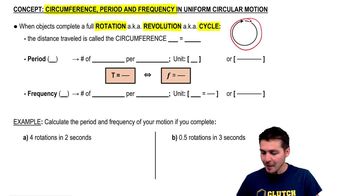
Circumference, Period, and Frequency in UCM

Tuning and Length Adjustment

In wind instruments like flutes, the pitch can be adjusted by changing the effective length of the air column inside the instrument. Extending the tuning joint increases the length, lowering the pitch. To remain in tune with a specific frequency, the flutist must calculate the necessary extension based on the change in speed of sound and the desired frequency.
Recommended video:
Guided course
10:54
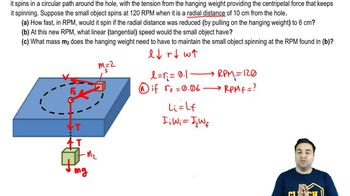
Spinning on a string of variable length
Related Practice
Textbook Question

Piano tuners tune pianos by listening to the beats between the harmonics of two different strings. When properly tuned, the note A should have a frequency of 440 Hz and the note E should be at 659 Hz. What is the frequency difference between the third harmonic of the A and the second harmonic of the E?

Textbook Question

The three identical loudspeakers in FIGURE P17.71 play a 170 Hz tone in a room where the speed of sound is 340 m/s. You are standing 4.0 m in front of the middle speaker. At this point, the amplitude of the wave from each speaker is a. When the amplitude is maximum, by what factor is the sound intensity greater than the sound intensity from a single speaker?

1
views
Textbook Question

Piano tuners tune pianos by listening to the beats between the harmonics of two different strings. When properly tuned, the note A should have a frequency of 440 Hz and the note E should be at 659 Hz. The tuner starts with the tension in the E string a little low, then tightens it. What is the frequency of the E string when she hears four beats per second?

1
views
Textbook Question

You have two small, identical boxes that generate 440 Hz notes. While holding one, you drop the other from a 20-m-high balcony. How many beats will you hear before the falling box hits the ground? You can ignore air resistance.

1
views
Textbook Question

Ultrasound has many medical applications, one of which is to monitor fetal heartbeats by reflecting ultrasound off a fetus in the womb. Consider an object moving at speed vo toward an at-rest source that is emitting sound waves of frequency f0. Show that the reflected wave (i.e., the echo) that returns to the source has a Doppler-shifted frequency fecho = (v+v0 / v-v0) f0 where v is the speed of sound in the medium.

8
views
Textbook Question

When mass M is tied to the bottom end of a long, thin wire suspended from the ceiling, the wire's second-harmonic frequency is 200 Hz. Adding an additional 1.0 kg to the hanging mass increases the second-harmonic frequency to 245 Hz. What is M?