

The three identical loudspeakers in FIGURE P17.71 play a 170 Hz tone in a room where the speed of sound is 340 m/s. You are standing 4.0 m in front of the middle speaker. At this point, the amplitude of the wave from each speaker is a. How far must speaker 2 be moved to the left to produce a maximum amplitude at the point where you are standing?
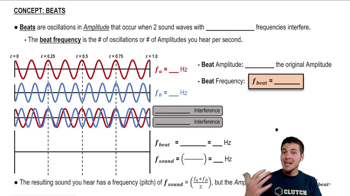
Piano tuners tune pianos by listening to the beats between the harmonics of two different strings. When properly tuned, the note A should have a frequency of 440 Hz and the note E should be at 659 Hz. The tuner starts with the tension in the E string a little low, then tightens it. What is the frequency of the E string when she hears four beats per second?
Verified step by step guidance
Verified video answer for a similar problem:
Key Concepts
Frequency and Beats
Tension and Frequency Relationship
Harmonics and Overtones
Piano tuners tune pianos by listening to the beats between the harmonics of two different strings. When properly tuned, the note A should have a frequency of 440 Hz and the note E should be at 659 Hz. What is the frequency difference between the third harmonic of the A and the second harmonic of the E?
The three identical loudspeakers in FIGURE P17.71 play a 170 Hz tone in a room where the speed of sound is 340 m/s. You are standing 4.0 m in front of the middle speaker. At this point, the amplitude of the wave from each speaker is a. When the amplitude is maximum, by what factor is the sound intensity greater than the sound intensity from a single speaker?
You have two small, identical boxes that generate 440 Hz notes. While holding one, you drop the other from a 20-m-high balcony. How many beats will you hear before the falling box hits the ground? You can ignore air resistance.
A flutist assembles her flute in a room where the speed of sound is 342 m/s. When she plays the note A, it is in perfect tune with a 440 Hz tuning fork. After a few minutes, the air inside her flute has warmed to where the speed of sound is 346 m/s. How far does she need to extend the 'tuning joint' of her flute to be in tune with the tuning fork?
When mass M is tied to the bottom end of a long, thin wire suspended from the ceiling, the wire's second-harmonic frequency is 200 Hz. Adding an additional 1.0 kg to the hanging mass increases the second-harmonic frequency to 245 Hz. What is M?
