

Piano tuners tune pianos by listening to the beats between the harmonics of two different strings. When properly tuned, the note A should have a frequency of 440 Hz and the note E should be at 659 Hz. What is the frequency difference between the third harmonic of the A and the second harmonic of the E?
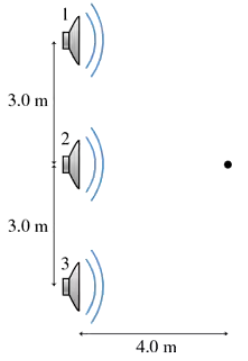
The three identical loudspeakers in FIGURE P17.71 play a 170 Hz tone in a room where the speed of sound is 340 m/s. You are standing 4.0 m in front of the middle speaker. At this point, the amplitude of the wave from each speaker is a. How far must speaker 2 be moved to the left to produce a maximum amplitude at the point where you are standing?

Verified step by step guidance
Verified video answer for a similar problem:
Key Concepts
Interference of Waves
Path Difference
Wavelength and Frequency Relationship
The three identical loudspeakers in FIGURE P17.71 play a 170 Hz tone in a room where the speed of sound is 340 m/s. You are standing 4.0 m in front of the middle speaker. At this point, the amplitude of the wave from each speaker is a. When the amplitude is maximum, by what factor is the sound intensity greater than the sound intensity from a single speaker?
Piano tuners tune pianos by listening to the beats between the harmonics of two different strings. When properly tuned, the note A should have a frequency of 440 Hz and the note E should be at 659 Hz. The tuner starts with the tension in the E string a little low, then tightens it. What is the frequency of the E string when she hears four beats per second?
Microwaves with a frequency of 10.5 GHz are aimed downward into a flat-bottomed beaker that contains sunflower oil. A microwave detector above the beaker finds that there are strong reflections when the oil depth is 2.76 cm and 3.68 cm but at no depths in between. What is the index of refraction of sunflower oil at microwave frequencies?
Engineers are testing a new thin-film coating whose index of refraction is less than that of glass. They deposit a 560-nm-thick layer on glass, then shine lasers on it. A red laser with a wavelength of 640 nm has no reflection at all, but a violet laser with a wavelength of 400 nm has a maximum reflection. How the coating behaves at other wavelengths is unknown. What is the coating’s index of refraction?
Scientists are testing a transparent material whose index of refraction for visible light varies with wavelength as n = 30.0 nm1/2/λ1/2 , where λ is in nm. If a 295-nm-thick coating is placed on glass (n=1.50), for what visible wavelengths will the reflected light have maximum constructive interference?
