
Ch 17: Superposition
Knight Calc - Physics for Scientists and Engineers 5th Edition
Knight Calc5th EditionPhysics for Scientists and EngineersISBN: 9780137344796Not the one you use?Change textbook
Chapter 17, Problem 81a

Ultrasound has many medical applications, one of which is to monitor fetal heartbeats by reflecting ultrasound off a fetus in the womb. Consider an object moving at speed vo toward an at-rest source that is emitting sound waves of frequency f0. Show that the reflected wave (i.e., the echo) that returns to the source has a Doppler-shifted frequency fecho = (v+v0 / v-v0) f0 where v is the speed of sound in the medium.

Verified step by step guidance
1
Step 1: Begin by understanding the Doppler effect, which describes the change in frequency of a wave as perceived by an observer moving relative to the source of the wave. In this case, the object (fetus) acts as a moving observer for the sound waves emitted by the source.
Step 2: First, calculate the frequency of the sound wave as perceived by the moving object (fetus). Using the Doppler effect formula for a moving observer, the observed frequency f_observed is given by: v + v0vf0, where v is the speed of sound in the medium, v0 is the speed of the object, and f0 is the frequency of the source.
Step 3: Next, consider the object (fetus) as a new source of sound waves, reflecting the sound back toward the original source. The reflected sound waves will have the frequency f_observed as their source frequency.
Step 4: Now, calculate the frequency of the reflected wave as perceived by the original source. Since the original source is stationary, use the Doppler effect formula for a stationary observer and a moving source. The frequency of the echo f_echo is given by: v + v0vfobserved, where f_observed is the frequency calculated in Step 2.
Step 5: Substitute the expression for f_observed from Step 2 into the formula for f_echo from Step 4. This results in: v + v0vv + v0vf0. Simplify the expression to obtain the final formula: v + v0v - v0f0.

Verified video answer for a similar problem:

This video solution was recommended by our tutors as helpful for the problem above.
Video duration:
2m
Was this helpful?

Key Concepts

Here are the essential concepts you must grasp in order to answer the question correctly.

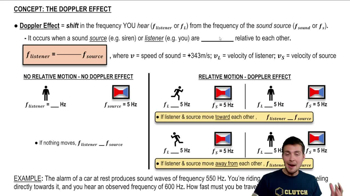
Doppler Effect

The Doppler Effect is a phenomenon observed when there is a relative motion between a source of waves and an observer. It describes how the frequency of waves changes based on the motion of the source and the observer. When the source moves toward the observer, the observed frequency increases, while it decreases when the source moves away. This effect is crucial in understanding how sound waves behave in various scenarios, including medical applications like ultrasound.
Recommended video:
Guided course
07:40
The Doppler Effect

Frequency Shift

Frequency shift refers to the change in frequency of a wave due to the relative motion between the source and the observer. In the context of the Doppler Effect, when an object moves toward a sound source, the waves are compressed, resulting in a higher frequency (blue shift). Conversely, if the object moves away, the waves are stretched, leading to a lower frequency (red shift). This shift is essential for calculating the frequency of the reflected wave in ultrasound applications.
Recommended video:
Guided course
05:08
Circumference, Period, and Frequency in UCM

Speed of Sound

The speed of sound is the rate at which sound waves propagate through a medium, typically air, water, or solids. It varies depending on the medium's properties, such as temperature and density. In the Doppler effect equation, the speed of sound (v) is a critical factor that influences the frequency of the waves as they travel to and from the moving object. Understanding this speed is vital for accurately interpreting the frequency shifts in ultrasound imaging.
Recommended video:
Guided course
05:17
Standing Sound Waves