Ch 12: Rotation of a Rigid Body
Knight Calc - Physics for Scientists and Engineers 5th Edition
Knight Calc5th EditionPhysics for Scientists and EngineersISBN: 9780137344796Not the one you use?Change textbook
Chapter 12, Problem 57

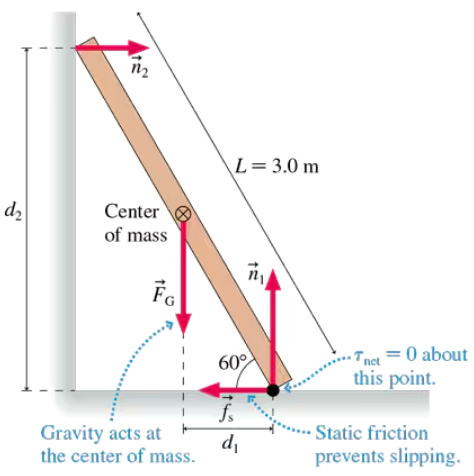
A 3.0-m-long ladder, as shown in Figure 12.35, leans against a frictionless wall. The coefficient of static friction between the ladder and the floor is 0.40. What is the minimum angle the ladder can make with the floor without slipping?

Verified step by step guidance
1
Step 1: Begin by analyzing the forces acting on the ladder. The ladder is in static equilibrium, meaning the sum of all forces and torques acting on it must be zero. Identify the forces: (1) the gravitational force acting downward at the ladder's center of mass, (2) the normal force exerted by the floor, (3) the frictional force at the base of the ladder, and (4) the normal force exerted by the wall.
Step 2: Write the equations for static equilibrium. For forces, the sum of horizontal forces must be zero: \( F_{friction} = F_{wall} \). The sum of vertical forces must also be zero: \( F_{normal, floor} = F_{gravity} \). For torques, choose the base of the ladder as the pivot point and set the sum of torques to zero.
Step 3: Express the torque equation. The torque due to gravity is \( \tau_{gravity} = F_{gravity} \cdot \frac{L}{2} \cdot \cos(\theta) \), where \( L \) is the length of the ladder and \( \theta \) is the angle the ladder makes with the floor. The torque due to the wall's normal force is \( \tau_{wall} = F_{wall} \cdot L \cdot \sin(\theta) \). Set \( \tau_{gravity} = \tau_{wall} \).
Step 4: Relate the frictional force to the normal force using the coefficient of static friction: \( F_{friction} \leq \mu \cdot F_{normal, floor} \), where \( \mu \) is the coefficient of static friction. Substitute \( F_{friction} = F_{wall} \) and \( F_{normal, floor} = F_{gravity} \) into this inequality.
Step 5: Combine the torque equation and the friction inequality to solve for the minimum angle \( \theta \). Rearrange the equations to isolate \( \theta \), ensuring that the ladder does not slip. Use trigonometric relationships to express \( \tan(\theta) \) in terms of \( \mu \) and other known quantities.

Verified video answer for a similar problem:

This video solution was recommended by our tutors as helpful for the problem above.
Video duration:
19m
Was this helpful?

Key Concepts

Here are the essential concepts you must grasp in order to answer the question correctly.

Static Friction

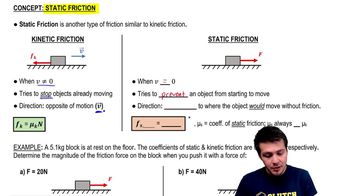
Static friction is the force that prevents an object from moving when it is at rest. It acts parallel to the surfaces in contact and is dependent on the normal force and the coefficient of static friction. In this scenario, the ladder's stability relies on the static friction between it and the floor, which must be sufficient to counteract the forces acting on the ladder.
Recommended video:
Guided course
08:11
Static Friction & Equilibrium

Equilibrium Conditions

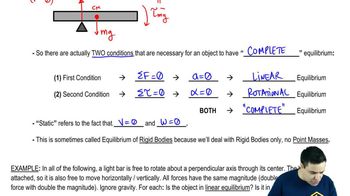
For the ladder to remain in equilibrium, the sum of forces and the sum of torques acting on it must be zero. This means that the upward force from the ground must balance the downward gravitational force, and the torque due to the weight of the ladder must be countered by the torque due to the frictional force at the base. Understanding these conditions is crucial for determining the minimum angle before slipping occurs.
Recommended video:
Guided course
10:13
Torque & Equilibrium

Angle of Inclination

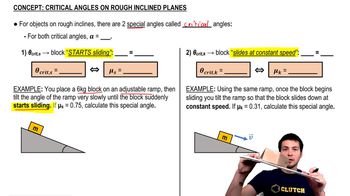
The angle of inclination refers to the angle formed between the ladder and the horizontal ground. This angle affects the distribution of forces acting on the ladder, including the normal force and the gravitational force. By analyzing how this angle influences the static friction and the forces at play, one can calculate the minimum angle required to prevent slipping.
Recommended video:
Guided course
08:27
Incline with Friction & Critical Angle
Related Practice
Textbook Question

A 40 kg, 5.0-m-long beam is supported by, but not attached to, the two posts in FIGURE P12.61. A 20 kg boy starts walking along the beam. How close can he get to the right end of the beam without it falling over?

1
views

Textbook Question

A person's center of mass is easily found by having the person lie on a reaction board. A horizontal, 2.5-m-long, 6.1 kg reaction board is supported only at the ends, with one end resting on a scale and the other on a pivot. A 60 kg woman lies on the reaction board with her feet over the pivot. The scale reads 25 kg. What is the distance from the woman's feet to her center of mass?

2
views
Textbook Question

A 4.0-cm-diameter disk with a 3.0-cm-diameter hole rolls down a 50-cm-long, 20° ramp. What is its speed at the bottom? What percent is this of the speed of a particle sliding down a frictionless ramp?

2
views
Textbook Question

Calculate the moment of inertia of the rectangular plate in FIGURE P12.55 for rotation about a perpendicular axis through the center.

1
views
Textbook Question

Calculate by direct integration the moment of inertia for a thin rod of mass M and length L about an axis located distance d from one end. Confirm that your answer agrees with Table 12.2 when d=0 and when d = L/2.

1
views
Textbook Question

Your task in a science contest is to stack four identical uniform bricks, each of length L, so that the top brick is as far to the right as possible without the stack falling over. Is it possible, as FIGURE P12.60 shows, to stack the bricks such that no part of the top brick is over the table? Answer this question by determining the maximum possible value of d.

2
views