
Ch 09: Work and Kinetic Energy
Knight Calc - Physics for Scientists and Engineers 5th Edition
Knight Calc5th EditionPhysics for Scientists and EngineersISBN: 9780137344796Not the one you use?Change textbook
Chapter 9, Problem 55

A 30 g mass is attached to one end of a 10-cm-long spring. The other end of the spring is connected to a frictionless pivot on a frictionless, horizontal surface. Spinning the mass around in a circle at 90 rpm causes the spring to stretch to a length of 12 cm. What is the value of the spring constant?

Verified step by step guidance
1
Step 1: Convert the given mass from grams to kilograms. Since 1 gram = 0.001 kilograms, the mass of 30 g is equivalent to 0.03 kg.
Step 2: Convert the angular velocity from revolutions per minute (rpm) to radians per second. Use the formula \( \omega = \frac{2 \pi \times \text{rpm}}{60} \), where \( \omega \) is the angular velocity in radians per second.
Step 3: Determine the centripetal force acting on the mass. The formula for centripetal force is \( F_c = m \omega^2 r \), where \( m \) is the mass, \( \omega \) is the angular velocity, and \( r \) is the radius of the circular motion (the stretched length of the spring, 12 cm, converted to meters).
Step 4: Recall Hooke's Law, which states \( F = k \Delta x \), where \( F \) is the force exerted by the spring, \( k \) is the spring constant, and \( \Delta x \) is the extension of the spring. The extension \( \Delta x \) is the difference between the stretched length (12 cm) and the original length (10 cm), converted to meters.
Step 5: Equate the centripetal force \( F_c \) to the spring force \( F \) and solve for the spring constant \( k \). Use the equation \( k = \frac{F_c}{\Delta x} \).

Verified video answer for a similar problem:

This video solution was recommended by our tutors as helpful for the problem above.
Video duration:
6m
Was this helpful?

Key Concepts

Here are the essential concepts you must grasp in order to answer the question correctly.

Hooke's Law

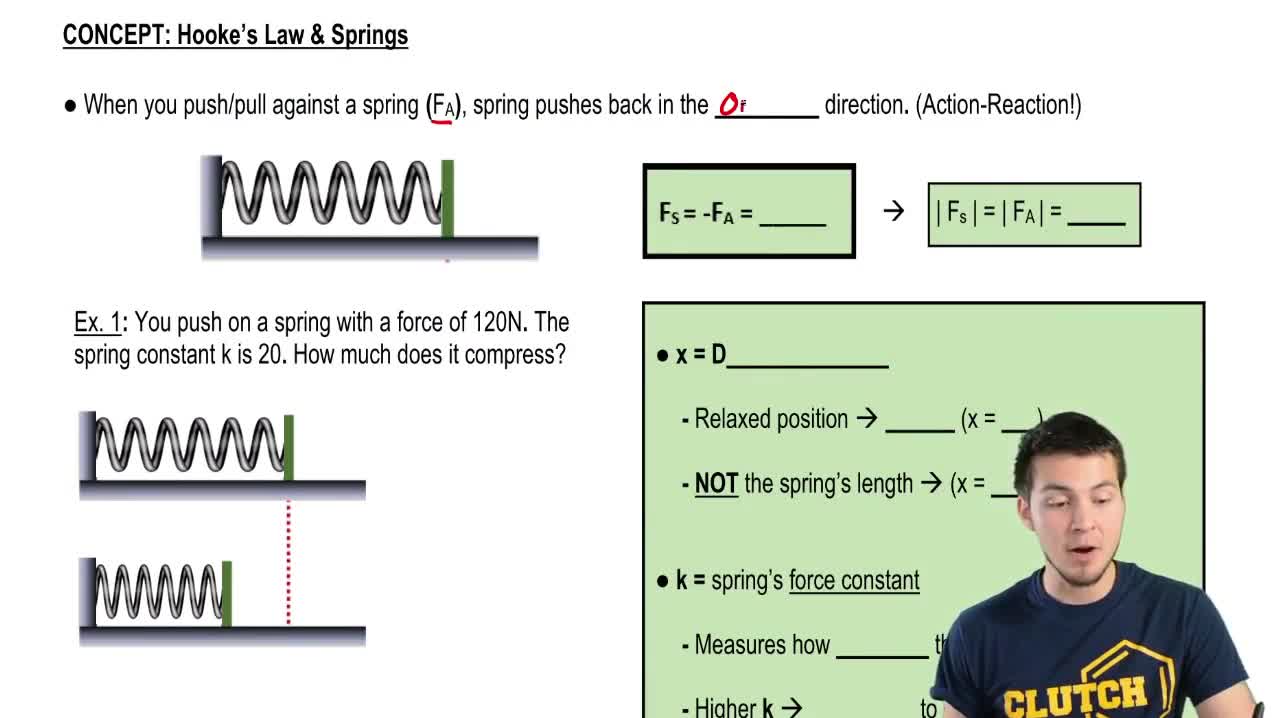
Hooke's Law states that the force exerted by a spring is directly proportional to its extension or compression from its equilibrium position, expressed as F = -kx, where F is the force, k is the spring constant, and x is the displacement. This principle is fundamental in understanding how springs behave under load and is essential for calculating the spring constant in this scenario.
Recommended video:
Guided course
05:27
Spring Force (Hooke's Law)

Centripetal Force

Centripetal force is the net force required to keep an object moving in a circular path, directed towards the center of the circle. It is calculated using the formula F_c = m(v^2/r), where m is the mass, v is the tangential velocity, and r is the radius of the circular path. In this problem, the centripetal force is provided by the spring's tension as it stretches.
Recommended video:
Guided course
06:48
Intro to Centripetal Forces

Conservation of Energy

The principle of conservation of energy states that energy cannot be created or destroyed, only transformed from one form to another. In this context, the potential energy stored in the spring when stretched is converted from the kinetic energy of the mass moving in a circular path. Understanding this relationship is crucial for determining the spring constant based on the energy changes involved.
Recommended video:
Guided course
06:24
Conservation Of Mechanical Energy
Related Practice
Textbook Question

A 50 g rock is placed in a slingshot and the rubber band is stretched. The magnitude of the force of the rubber band on the rock is shown by the graph in FIGURE P9.56. The rubber band is stretched 30 cm and then released. What is the speed of the rock?

2
views
Textbook Question

A horizontal spring with spring constant 250 N/m is compressed by 12 cm and then used to launch a 250 g box across the floor. The coefficient of kinetic friction between the box and the floor is 0.23. What is the box's launch speed?

1
views
Textbook Question

How much work does tension do to pull the mass from the bottom of the hill (θ = 0) to the top at constant speed? To answer this question, write an expression for the work done when the mass moves through a very small distance ds while it has angle θ, replace ds with an equivalent expression involving R and dθ, then integrate.

1
views
Textbook Question

The gravitational attraction between two objects with masses mA and mB, separated by distance 𝓍, is F = GmAmB/𝓍², where G is the gravitational constant. If one mass is much greater than the other, the larger mass stays essentially at rest while the smaller mass moves toward it. Suppose a 1.5 x 10¹³ kg comet is passing the orbit of Mars, heading straight for the sun at a speed of 3.5 x 10⁴ m/s. What will its speed be when it crosses the orbit of Mercury? Astronomical data are given in the tables at the back of the book, and G = 6.67 x 10⁻¹¹ Nm²/kg².

1
views
Textbook Question

A red ball has a mass of 250 g. A constant force pushes the red ball horizontally and launches it at a speed of 15 m/s. The same force pushes a green ball through the same distance, launching it at 25 m/s. What is the mass of the green ball?

1
views
Textbook Question

A 737-800 jet airliner has twin engines, each with 105 kN thrust. A 78,000 kg jet reaches a takeoff speed of 70 m/s in a distance of 1100 m. What is the increase in thermal energy due to rolling friction and air drag?