
Ch 09: Work and Kinetic Energy
Knight Calc - Physics for Scientists and Engineers 5th Edition
Knight Calc5th EditionPhysics for Scientists and EngineersISBN: 9780137344796Not the one you use?Change textbook
Chapter 9, Problem 57b

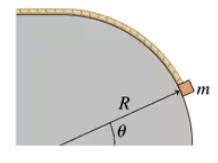
How much work does tension do to pull the mass from the bottom of the hill (θ = 0) to the top at constant speed? To answer this question, write an expression for the work done when the mass moves through a very small distance ds while it has angle θ, replace ds with an equivalent expression involving R and dθ, then integrate.

Verified step by step guidance
1
Step 1: Recall the formula for work done by a force: \( W = \int F \cdot ds \), where \( F \) is the force and \( ds \) is the infinitesimal displacement. In this case, the force is tension, and the displacement is along the hill.
Step 2: Express \( ds \) in terms of the radius \( R \) and the angle \( \theta \). The arc length \( ds \) for a small angular displacement \( d\theta \) is given by \( ds = R \cdot d\theta \).
Step 3: Write the expression for the work done over a small displacement \( ds \): \( dW = T \cdot ds \), where \( T \) is the tension force. Substitute \( ds = R \cdot d\theta \) into this equation to get \( dW = T \cdot R \cdot d\theta \).
Step 4: Integrate the expression for \( dW \) over the range of \( \theta \) from \( 0 \) to \( \pi \) (assuming the hill spans this angular range): \( W = \int_{0}^{\pi} T \cdot R \cdot d\theta \).
Step 5: Since the tension \( T \) and radius \( R \) are constants, they can be factored out of the integral. The final expression for the work done is \( W = T \cdot R \cdot \int_{0}^{\pi} d\theta \). Evaluate the integral \( \int_{0}^{\pi} d\theta \) to find the total work done.

Verified video answer for a similar problem:

This video solution was recommended by our tutors as helpful for the problem above.
Video duration:
5m
Was this helpful?

Key Concepts

Here are the essential concepts you must grasp in order to answer the question correctly.

Work

Work is defined as the product of the force applied to an object and the distance over which that force is applied, in the direction of the force. Mathematically, it is expressed as W = F · d, where W is work, F is the force, and d is the displacement. In this context, understanding how tension contributes to work is crucial, especially since the mass is being moved at a constant speed, indicating that the net work done is zero.
Recommended video:
Guided course
06:58
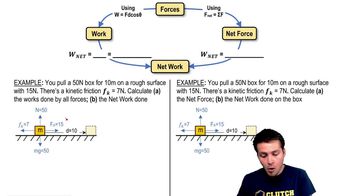
Calculating Net Work

Tension

Tension is the force exerted by a string, rope, or cable when it is pulled tight by forces acting from opposite ends. In this scenario, tension is responsible for moving the mass up the hill against gravitational forces. The angle θ affects the effective component of tension that does work in the direction of the mass's movement, making it essential to analyze how tension varies with the angle during the ascent.
Recommended video:
Guided course
06:34
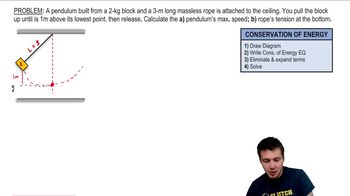
Calculating Tension in a Pendulum with Energy Conservation

Integration

Integration is a mathematical technique used to find the total accumulation of a quantity, such as work done over a distance. In this problem, we need to integrate the expression for work done over a small distance ds, which is expressed in terms of the radius R and the angle dθ. This process allows us to calculate the total work done as the mass moves from the bottom to the top of the hill, taking into account the changing angle of tension.
Recommended video:
Guided course
11:43
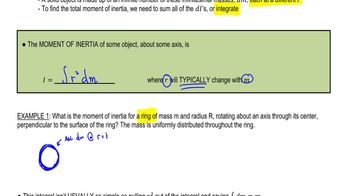
Finding Moment Of Inertia By Integrating
Related Practice
Textbook Question

A spring of equilibrium length L₁ and spring constant k₁ hangs from the ceiling. Mass m₁ is suspended from its lower end. Then a second spring, with equilibrium length L₂ and spring constant k₂, is hung from the bottom of m₁. Mass m₂ is suspended from this second spring. How far is m₂ below the ceiling?

2
views
Textbook Question

A 50 g rock is placed in a slingshot and the rubber band is stretched. The magnitude of the force of the rubber band on the rock is shown by the graph in FIGURE P9.56. The rubber band is stretched 30 cm and then released. What is the speed of the rock?

2
views
Textbook Question

A horizontal spring with spring constant 250 N/m is compressed by 12 cm and then used to launch a 250 g box across the floor. The coefficient of kinetic friction between the box and the floor is 0.23. What is the box's launch speed?

1
views
Textbook Question

A 90 kg firefighter needs to climb the stairs of a 20-m-tall building while carrying a 40 kg backpack filled with gear. How much power does he need to reach the top in 55 s?

1
views
Textbook Question

A red ball has a mass of 250 g. A constant force pushes the red ball horizontally and launches it at a speed of 15 m/s. The same force pushes a green ball through the same distance, launching it at 25 m/s. What is the mass of the green ball?

1
views
Textbook Question

A 30 g mass is attached to one end of a 10-cm-long spring. The other end of the spring is connected to a frictionless pivot on a frictionless, horizontal surface. Spinning the mass around in a circle at 90 rpm causes the spring to stretch to a length of 12 cm. What is the value of the spring constant?

2
views