
Ch 09: Work and Kinetic Energy
Knight Calc - Physics for Scientists and Engineers 5th Edition
Knight Calc5th EditionPhysics for Scientists and EngineersISBN: 9780137344796Not the one you use?Change textbook
Chapter 9, Problem 56

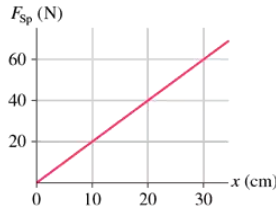
A 50 g rock is placed in a slingshot and the rubber band is stretched. The magnitude of the force of the rubber band on the rock is shown by the graph in FIGURE P9.56. The rubber band is stretched 30 cm and then released. What is the speed of the rock?

Verified step by step guidance
1
Step 1: Analyze the graph provided. The graph shows the force exerted by the rubber band (F) as a function of the stretch distance (x). The force increases linearly from 0 N at 0 cm to 30 N at 30 cm. This indicates that the force follows Hooke's Law, where F = kx, and k is the spring constant.
Step 2: Determine the spring constant (k) using the slope of the graph. From the graph, the force increases by 30 N over a stretch of 30 cm (0.30 m). Using the formula k = F/x, calculate k = 30 N / 0.30 m.
Step 3: Calculate the elastic potential energy stored in the rubber band when stretched to 30 cm. The formula for elastic potential energy is U = (1/2)kx², where x is the stretch distance in meters. Substitute the values of k and x into the formula.
Step 4: Use the principle of energy conservation. The elastic potential energy stored in the rubber band is converted into the kinetic energy of the rock when the rubber band is released. The formula for kinetic energy is KE = (1/2)mv², where m is the mass of the rock and v is its speed. Set U = KE and solve for v.
Step 5: Convert the mass of the rock from grams to kilograms (50 g = 0.050 kg) and substitute the values of m and U into the equation to solve for v. This will give the speed of the rock.

Verified video answer for a similar problem:

This video solution was recommended by our tutors as helpful for the problem above.
Video duration:
5m
Was this helpful?

Key Concepts

Here are the essential concepts you must grasp in order to answer the question correctly.

Hooke's Law

Hooke's Law states that the force exerted by a spring or elastic material is directly proportional to the amount it is stretched or compressed, up to its elastic limit. Mathematically, it is expressed as F = kx, where F is the force, k is the spring constant, and x is the displacement from the equilibrium position. In this scenario, the rubber band behaves similarly, and the graph indicates how the force increases with the stretch of the band.
Recommended video:
Guided course
05:27
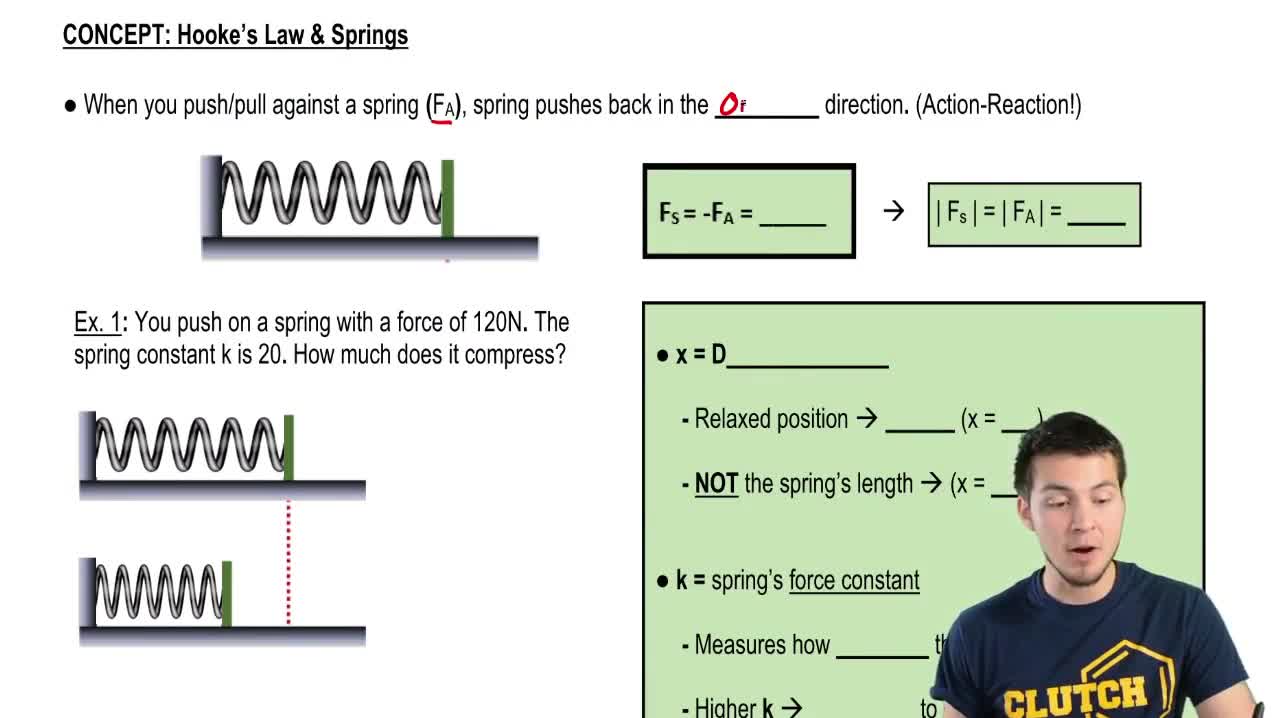
Spring Force (Hooke's Law)

Kinetic Energy

Kinetic energy is the energy possessed by an object due to its motion, calculated using the formula KE = 1/2 mv², where m is the mass and v is the velocity of the object. When the rubber band is released, the potential energy stored in the stretched band converts into kinetic energy, propelling the rock forward. Understanding this relationship is crucial for determining the speed of the rock after release.
Recommended video:
Guided course
06:07
Intro to Rotational Kinetic Energy

Work-Energy Principle

The work-energy principle states that the work done on an object is equal to the change in its kinetic energy. In this case, the work done by the rubber band on the rock as it stretches and then releases translates into the rock's kinetic energy. By calculating the area under the force vs. displacement graph, we can determine the work done, which helps in finding the final speed of the rock.
Recommended video:
Guided course
04:10
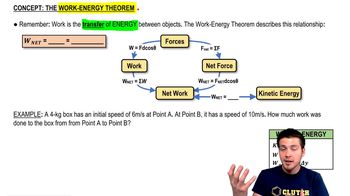
The Work-Energy Theorem
Related Practice
Textbook Question

A spring of equilibrium length L₁ and spring constant k₁ hangs from the ceiling. Mass m₁ is suspended from its lower end. Then a second spring, with equilibrium length L₂ and spring constant k₂, is hung from the bottom of m₁. Mass m₂ is suspended from this second spring. How far is m₂ below the ceiling?

2
views
Textbook Question

A horizontal spring with spring constant 250 N/m is compressed by 12 cm and then used to launch a 250 g box across the floor. The coefficient of kinetic friction between the box and the floor is 0.23. What is the box's launch speed?

1
views
Textbook Question

How much work does tension do to pull the mass from the bottom of the hill (θ = 0) to the top at constant speed? To answer this question, write an expression for the work done when the mass moves through a very small distance ds while it has angle θ, replace ds with an equivalent expression involving R and dθ, then integrate.

1
views
Textbook Question

The gravitational attraction between two objects with masses mA and mB, separated by distance 𝓍, is F = GmAmB/𝓍², where G is the gravitational constant. If one mass is much greater than the other, the larger mass stays essentially at rest while the smaller mass moves toward it. Suppose a 1.5 x 10¹³ kg comet is passing the orbit of Mars, heading straight for the sun at a speed of 3.5 x 10⁴ m/s. What will its speed be when it crosses the orbit of Mercury? Astronomical data are given in the tables at the back of the book, and G = 6.67 x 10⁻¹¹ Nm²/kg².

1
views
Textbook Question

A red ball has a mass of 250 g. A constant force pushes the red ball horizontally and launches it at a speed of 15 m/s. The same force pushes a green ball through the same distance, launching it at 25 m/s. What is the mass of the green ball?

1
views
Textbook Question

A 30 g mass is attached to one end of a 10-cm-long spring. The other end of the spring is connected to a frictionless pivot on a frictionless, horizontal surface. Spinning the mass around in a circle at 90 rpm causes the spring to stretch to a length of 12 cm. What is the value of the spring constant?

2
views