
Ch 10: Dynamics of Rotational Motion
Young & Freedman Calc - University Physics 14th Edition
Young & Freedman Calc14th EditionUniversity PhysicsISBN: 9780321973610Not the one you use?Change textbook
Chapter 10, Problem 5a

One force acting on a machine part is F = (-5.00 N)i + (4.00 N)j. The vector from the origin to the point where the force is applied is r = (-0.450 m)i +(0.150 m)j. In a sketch, show r, F, and the origin.

Verified step by step guidance
1
Understand the problem: We have a force vector \( \mathbf{F} = (-5.00 \text{ N})\mathbf{i} + (4.00 \text{ N})\mathbf{j} \) and a position vector \( \mathbf{r} = (-0.450 \text{ m})\mathbf{i} + (0.150 \text{ m})\mathbf{j} \). We need to sketch these vectors starting from the origin.
Draw the coordinate axes: Begin by drawing a standard Cartesian coordinate system with the x-axis and y-axis intersecting at the origin (0,0).
Plot the position vector \( \mathbf{r} \): From the origin, move 0.450 meters in the negative x-direction (left) and 0.150 meters in the positive y-direction (up). Mark this point and draw an arrow from the origin to this point to represent \( \mathbf{r} \).
Plot the force vector \( \mathbf{F} \): From the origin, move 5.00 N in the negative x-direction (left) and 4.00 N in the positive y-direction (up). Draw an arrow from the origin to this point to represent \( \mathbf{F} \).
Label the vectors: Clearly label the position vector as \( \mathbf{r} \) and the force vector as \( \mathbf{F} \) on your sketch. Ensure the origin is marked as well.

Verified video answer for a similar problem:

This video solution was recommended by our tutors as helpful for the problem above.
Video duration:
3m
Was this helpful?

Key Concepts

Here are the essential concepts you must grasp in order to answer the question correctly.

Vector Representation

Vectors are mathematical entities used to represent quantities that have both magnitude and direction, such as force and position. In this problem, the force vector F and position vector r are expressed in terms of their components along the i (x-axis) and j (y-axis) directions, which helps in visualizing and calculating their effects in a two-dimensional plane.
Recommended video:
Guided course
06:44
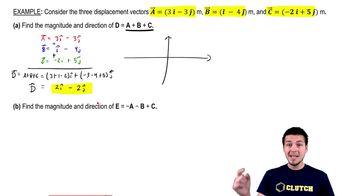
Adding 3 Vectors in Unit Vector Notation

Vector Addition and Subtraction

Vector addition and subtraction are operations that combine or resolve vectors into resultant vectors. This concept is crucial for understanding how different forces and positions interact in a system. In the given problem, understanding how to graphically represent and manipulate these vectors is essential for sketching the scenario accurately.
Recommended video:
Guided course
05:58
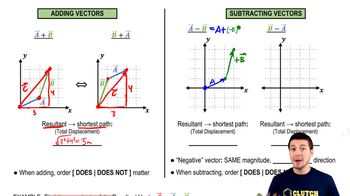
Subtracting Vectors Graphically

Coordinate System

A coordinate system is a framework used to define the position of points in space, typically using axes like the x-axis and y-axis. In this problem, the origin is the reference point from which the position vector r is measured, and it is essential to understand how vectors are positioned relative to this origin to accurately sketch the scenario.
Recommended video:
Guided course
05:17
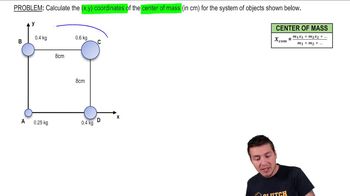
Coordinates of Center of Mass of 4 objects