Three forces are applied to a wheel of radius 0.350 m, as shown in Fig. E10.4. One force is perpendicular to the rim, one is tangent to it, and the other one makes a 40.0° angle with the radius. What is the net torque on the wheel due to these three forces for an axis perpendicular to the wheel and passing through its center?
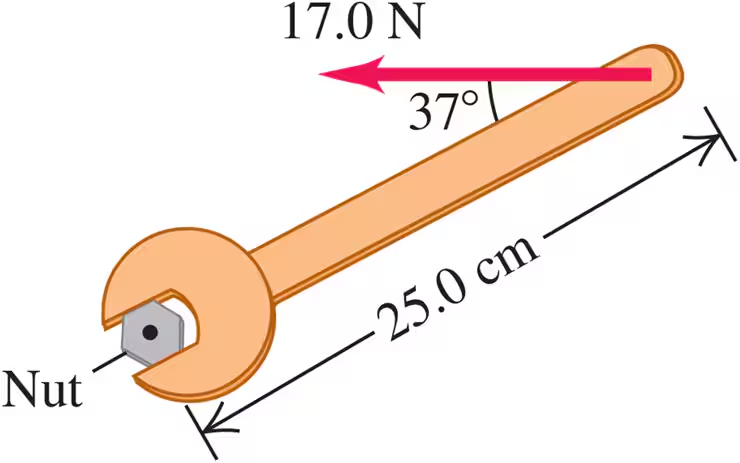
A machinist is using a wrench to loosen a nut. The wrench is 25.0 cm long, and he exerts a 17.0-N force at the end of the handle at 37° with the handle (Fig. E10.7). What torque does the machinist exert about the center of the nut?

Verified step by step guidance
Verified video answer for a similar problem:
Key Concepts
Torque
Lever Arm
Angle of Force Application
A metal bar is in the -plane with one end of the bar at the origin. A force is applied to the bar at the point , . What are the magnitude and direction of the torque with respect to the origin produced by ?
One force acting on a machine part is F = (-5.00 N)i + (4.00 N)j. The vector from the origin to the point where the force is applied is r = (-0.450 m)i +(0.150 m)j. In a sketch, show r, F, and the origin.
A machinist is using a wrench to loosen a nut. The wrench is 25.0 cm long, and he exerts a 17.0-N force at the end of the handle at 37° with the handle (Fig. E10.7). What is the maximum torque he could exert with this force, and how should the force be oriented?
The flywheel of an engine has moment of inertia 1.60 kg/m2 about its rotation axis. What constant torque is required to bring it up to an angular speed of 400 rev/min in 8.00 s, starting from rest?
A metal bar is in the -plane with one end of the bar at the origin. A force is applied to the bar at the point , . In terms of unit vectors and , what is the position vector for the point where the force is applied?
