
Ch 10: Dynamics of Rotational Motion
Young & Freedman Calc - University Physics 14th Edition
Young & Freedman Calc14th EditionUniversity PhysicsISBN: 9780321973610Not the one you use?Change textbook
Chapter 10, Problem 6b

A metal bar is in the xyxy-plane with one end of the bar at the origin. A force F=(7.00N)i+(3.00N)j\(\overrightarrow{F}\)=\(\left\)(7.00N\(\right\))i+(-3.00N)j is applied to the bar at the point x=3.00 mx=3.00\(\text{ m}\), y=4.00 my=4.00\(\text{ m}\). What are the magnitude and direction of the torque with respect to the origin produced by F\(\overrightarrow{F}\)?

Verified step by step guidance
1
First, understand that torque (τ) is a measure of the rotational force applied to an object. It is calculated using the cross product of the position vector (r) and the force vector (F). The formula for torque is τ = r × F.
Identify the position vector r from the origin to the point where the force is applied. In this case, r = (3.00 m)i + (4.00 m)j.
Write the force vector F, which is given as F = (7.00 N)i + (-3.00 N)j.
Calculate the cross product r × F. The cross product in two dimensions can be simplified using the determinant of a matrix: |i j k| |3.00 4.00 0| |7.00 -3.00 0|. Since the vectors are in the xy-plane, the k-component will give the magnitude of the torque.
Determine the magnitude of the torque, which is the absolute value of the k-component from the cross product. The direction of the torque is given by the right-hand rule, which indicates whether the rotation is clockwise or counterclockwise.

Verified video answer for a similar problem:

This video solution was recommended by our tutors as helpful for the problem above.
Video duration:
7m
Was this helpful?

Key Concepts

Here are the essential concepts you must grasp in order to answer the question correctly.

Torque

Torque is a measure of the rotational force applied to an object, calculated as the cross product of the position vector and the force vector. It determines how effectively a force can cause an object to rotate around a pivot point. The magnitude of torque is given by τ = rFsinθ, where r is the distance from the pivot, F is the force, and θ is the angle between r and F.
Recommended video:
Guided course
08:55
Net Torque & Sign of Torque

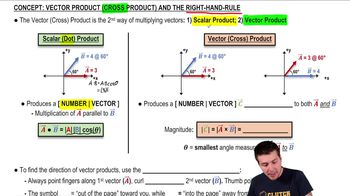
Cross Product

The cross product is a mathematical operation used to find a vector perpendicular to two given vectors in three-dimensional space. For vectors A and B, the cross product A × B results in a vector whose magnitude is |A||B|sinθ, where θ is the angle between A and B. In the context of torque, it helps determine the direction and magnitude of rotational force.
Recommended video:
Guided course
10:30
Vector (Cross) Product and the Right-Hand-Rule

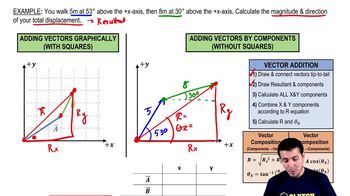
Vector Components

Vector components are the projections of a vector along the axes of a coordinate system, typically expressed in terms of i, j, and k unit vectors. Understanding vector components is crucial for calculating torque, as it involves breaking down the force vector into its x and y components to apply the cross product with the position vector, which also has x and y components.
Recommended video:
Guided course
07:30
Vector Addition By Components
Related Practice
Textbook Question

Calculate the torque (magnitude and direction) about point O due to the force F in each of the cases sketched in Fig. E10.1. In each case, both the force F and the rod lie in the plane of the page, the rod has length 4.00 m, and the force has magnitude F = 10.0 N.

Textbook Question

One force acting on a machine part is F = (-5.00 N)i + (4.00 N)j. The vector from the origin to the point where the force is applied is r = (-0.450 m)i +(0.150 m)j. In a sketch, show r, F, and the origin.

3
views
Textbook Question

A machinist is using a wrench to loosen a nut. The wrench is 25.0 cm long, and he exerts a 17.0-N force at the end of the handle at 37° with the handle (Fig. E10.7). What is the maximum torque he could exert with this force, and how should the force be oriented?

2
views
Textbook Question

The flywheel of an engine has moment of inertia 1.60 kg/m2 about its rotation axis. What constant torque is required to bring it up to an angular speed of 400 rev/min in 8.00 s, starting from rest?

1
views
Textbook Question

A machinist is using a wrench to loosen a nut. The wrench is 25.0 cm long, and he exerts a 17.0-N force at the end of the handle at 37° with the handle (Fig. E10.7). What torque does the machinist exert about the center of the nut?

1
views
Textbook Question

A metal bar is in the xyxy-plane with one end of the bar at the origin. A force F=(7.00N)i+(3.00N)j\(\overrightarrow{F}\)=\(\left\)(7.00N\(\right\))i+(-3.00N)j is applied to the bar at the point x=3.00 mx=3.00\(\text{ m}\), y=4.00 my=4.00\(\text{ m}\). In terms of unit vectors ii and jj, what is the position vector rr for the point where the force is applied?

2
views