A 100-W, 120-V incandescent lightbulb has a resistance of 12 Ω when cold (20°C) and 150 Ω when on (hot). Calculate its power consumption (a) at the instant it is turned on, and (b) after a few moments when it is hot.
Ch. 25 - Electric Current and Resistance
Giancoli Douglas5th editionPhysics for Scientists and EngineersISBN: 9780137488179Not the one you use?Change textbook
Chapter 24, Problem 81b
Suppose a current is given by the equation I = 1.40 sin 210t, where I is in amperes and t in seconds. What is the rms value of the current?
Verified step by step guidance1
The given current is expressed as a sinusoidal function: I = 1.40 sin(210t), where the amplitude of the current is 1.40 A. The root mean square (rms) value of a sinusoidal current is related to its amplitude.
The formula for the rms value of a sinusoidal current is: , where is the peak (amplitude) current.
Substitute the amplitude of the current, A, into the formula: .
Simplify the expression to calculate the rms value. Note that is approximately 1.414, but leave the result in terms of the fraction for now.
The final expression for the rms value of the current is: . You can calculate the numerical value if needed.

Verified video answer for a similar problem:
This video solution was recommended by our tutors as helpful for the problem above.
Video duration:
2mWas this helpful?
Key Concepts
Here are the essential concepts you must grasp in order to answer the question correctly.
Root Mean Square (RMS) Value
The RMS value of an alternating current (AC) is a measure of the effective value of the current, which is equivalent to a direct current (DC) that would produce the same power in a resistive load. It is calculated by taking the square of the instantaneous values, averaging them over a complete cycle, and then taking the square root of that average.
Recommended video:
Guided course
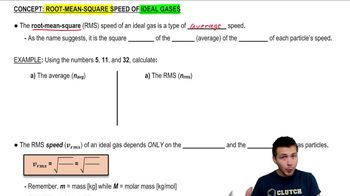
Root-Mean-Square Speed of Ideal Gases
Sine Wave Function
The sine wave function describes how the current varies with time in AC circuits. In the equation I = 1.40 sin(210t), the sine function indicates that the current oscillates between positive and negative values, with a peak amplitude of 1.40 A and a frequency determined by the coefficient of t, which affects the rate of oscillation.
Recommended video:
Guided course
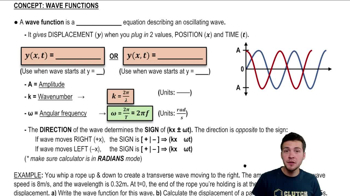
Intro to Wave Functions
Frequency and Angular Frequency
Frequency refers to the number of cycles a wave completes in one second, measured in hertz (Hz). Angular frequency, denoted by the term inside the sine function (in this case, 210), is related to frequency by the equation ω = 2πf, where ω is the angular frequency in radians per second. This concept is crucial for determining the time period and behavior of the current over time.
Recommended video:
Guided course
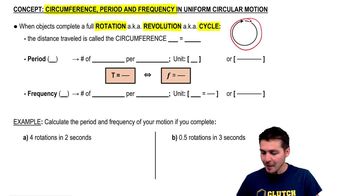
Circumference, Period, and Frequency in UCM
Related Practice
Textbook Question
1
views
Textbook Question
A 2800-W oven is connected to a 240-V source. How long will it take to bring 150 mL of 15°C water to 100°C assuming 65% efficiency?
2
views
Textbook Question
Lightbulb A is rated at 120 V and 40 W for household applications. Lightbulb B is rated at 12 V and 40 W for automotive applications. What is the resistance of each bulb?
1
views
Textbook Question
Lightbulb A is rated at 120 V and 40 W for household applications. Lightbulb B is rated at 12 V and 40 W for automotive applications. What is the current through each bulb?
2
views
Textbook Question
A microwave oven running at 72% efficiency delivers 950 W to the interior. Find the power drawn from the source.
1
views
Textbook Question
What is the average current drawn by a 1.0-hp 120-V motor? (1 hp = 746 W.)
1
views