Ch. 25 - Electric Current and Resistance
Giancoli Douglas - Physics for Scientists and Engineers 5th edition
Giancoli Douglas5th editionPhysics for Scientists and EngineersISBN: 9780137488179Not the one you use?Change textbook
Chapter 24, Problem 82

A 100-W, 120-V incandescent lightbulb has a resistance of 12 Ω when cold (20°C) and 150 Ω when on (hot). Calculate its power consumption (a) at the instant it is turned on, and (b) after a few moments when it is hot.

Verified step by step guidance
1
Step 1: Understand the problem. The power consumption of the lightbulb depends on its resistance and the voltage applied. When the bulb is cold, its resistance is 12 Ω, and when it is hot, its resistance is 150 Ω. Use the formula for power: P = V² / R, where P is power, V is voltage, and R is resistance.
Step 2: For part (a), calculate the power consumption at the instant the bulb is turned on (cold resistance). Substitute the given values into the formula: P = (120²) / 12. Simplify the expression to find the power when the bulb is cold.
Step 3: For part (b), calculate the power consumption after the bulb has been on for a while (hot resistance). Substitute the given values into the formula: P = (120²) / 150. Simplify the expression to find the power when the bulb is hot.
Step 4: Compare the results from part (a) and part (b). Notice that the power consumption is higher when the bulb is cold because the resistance is lower, and it decreases as the bulb heats up and its resistance increases.
Step 5: Reflect on the physical meaning. The change in resistance is due to the temperature dependence of the filament material. As the filament heats up, its resistance increases, which reduces the current and power consumption over time.

Verified video answer for a similar problem:

This video solution was recommended by our tutors as helpful for the problem above.
Video duration:
9m
Was this helpful?

Key Concepts

Here are the essential concepts you must grasp in order to answer the question correctly.

Ohm's Law

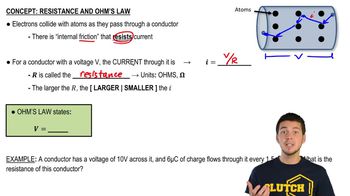
Ohm's Law states that the current (I) flowing through a conductor between two points is directly proportional to the voltage (V) across the two points and inversely proportional to the resistance (R) of the conductor. It is mathematically expressed as V = I * R. This principle is essential for calculating the current in the lightbulb when it is turned on and when it is hot.
Recommended video:
Guided course
03:07
Resistance and Ohm's Law

Power in Electrical Circuits

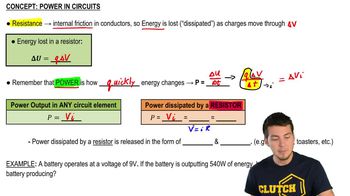
The power (P) consumed by an electrical device is defined as the product of the voltage (V) across it and the current (I) flowing through it, expressed as P = V * I. This concept is crucial for determining the power consumption of the lightbulb at both cold and hot states, as it allows us to calculate how much energy is being used.
Recommended video:
Guided course
06:18
Power in Circuits

Temperature Dependence of Resistance

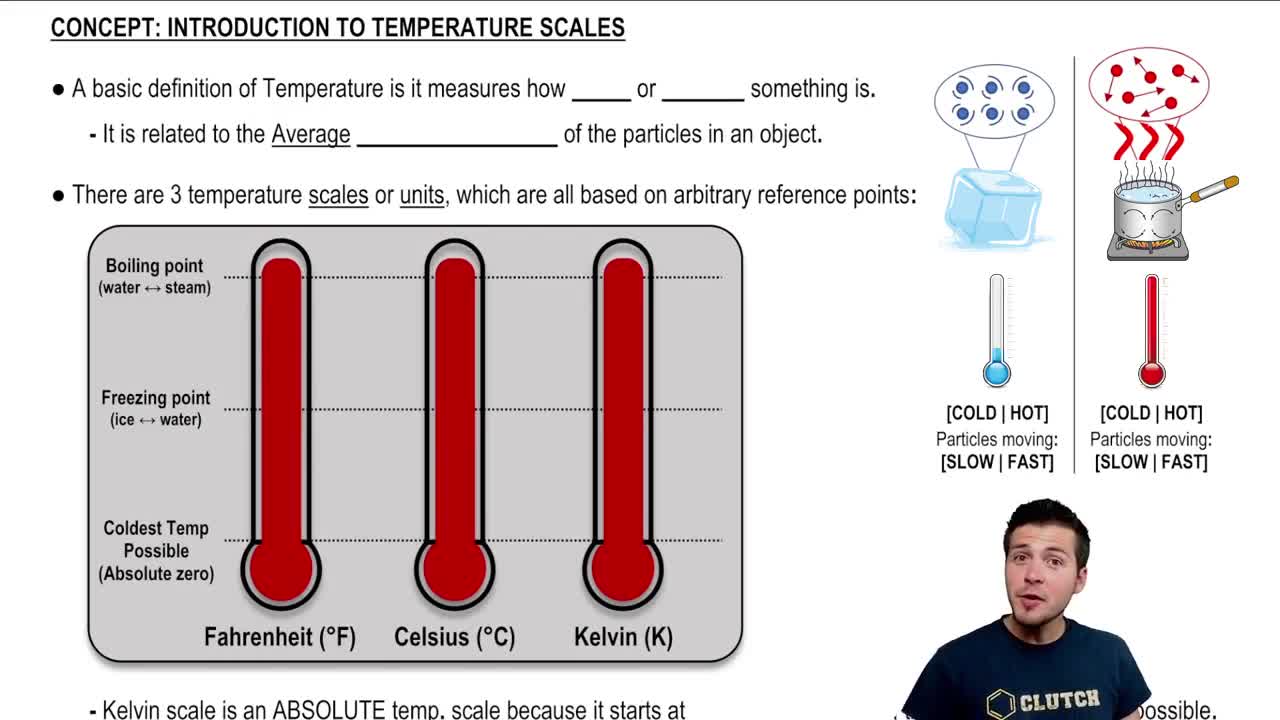
The resistance of materials, particularly metals, typically increases with temperature. In the case of the incandescent lightbulb, its cold resistance is 12 Ω at 20°C, but it rises to 150 Ω when the bulb is hot. Understanding this temperature dependence is vital for accurately calculating the power consumption at the moment it is turned on versus after it has warmed up.
Recommended video:
Guided course
04:54
Introduction To Temperature Scales