
The level of liquid helium (temperature ≈ 4K) in its storage tank can be monitored using a vertically aligned niobium–titanium (NbTi) wire, whose length ℓ spans the height of the tank. In this level-sensing setup, an electronic circuit maintains a constant electrical current I at all times in the NbTi wire and a voltmeter monitors the voltage V across this wire. The NbTi wire is superconducting ( R = 0) if below its transition temperature of 10 K, so the portion of the wire immersed in the liquid helium is in the superconducting state, while the portion above the liquid (in helium vapor with temperature above 10 K) is in the normal state. Define ƒ = x/ℓ to be the fraction of the tank filled with liquid helium (Fig. 25–40) and V₀ to be the value of the voltage V when the tank is empty (ƒ = 0) . Determine the relation between f and V (in terms of V₀).

- Ch. 01 - Introduction, Measurement, Estimating10
- Ch. 02 - Describing Motion: Kinematics in One Dimension30
- Ch. 03 - Kinematics in Two or Three Dimensions; Vectors15
- Ch. 04 - Dynamics: Newton's Laws of Motion16
- Ch. 05 - Using Newton's Laws: Friction, Circular Motion, Drag Forces22
- Ch. 06 - Gravitation and Newton's Synthesis10
- Ch. 07 - Work and Energy21
- Ch. 08 - Conservation of Energy33
- Ch. 09 - Linear Momentum26
- Ch. 10 - Rotational Motion41
- Ch. 11 - Angular Momentum; General Rotation27
- Ch. 12 - Static Equilibrium; Elasticity and Fracture27
- Ch. 13 - Fluids28
- Ch. 14 - Oscillations14
- Ch. 15 - Wave Motion35
- Ch. 16 - Sound5
- Ch. 17 - Temperature, Thermal Expansion, and the Ideal Gas Law40
- Ch. 18 - Kinetic Theory of Gases18
- Ch. 19 - Heat and the First Law of Thermodynamics31
- Ch. 20 - Second Law of Thermodynamics32
- Ch. 21 - Electric Charge and Electric Field7
- Ch. 23 - Electric Potential20
- Ch. 24 - Capacitance, Dielectrics, Electric Energy, Storage15
- Ch. 25 - Electric Current and Resistance32
- Ch. 26 - DC Circuits22
- Ch. 27 - Magnetism21
- Ch. 28 - Sources of Magnetic Field24
- Ch. 29 - Electromagnetic Induction and Faraday's Law21
- Ch. 30 - Inductance, Electromagnetic Oscillations, and AC Circuits42
- Ch. 31 - Maxwell's Equations and Electromagnetic Waves25
- Ch. 32 - Light: Reflection and Refraction42
- Ch. 33 - Lenses and Optical Instruments21
- Ch. 34 - The Wave Nature of Light: Interference and Polarization26
- Ch. 35 - Diffraction24
- Ch. 36 - The Special Theory of Relativity29
- Ch. 38 - Quantum Mechanics1
- Ch. 40 - Molecules and Solids6
- Ch. 43 - Elementary Particles3
- Ch. 44 - Astrophysics and Cosmology9
Lightbulb A is rated at 120 V and 40 W for household applications. Lightbulb B is rated at 12 V and 40 W for automotive applications. What is the resistance of each bulb?
 Verified step by step guidance
Verified video answer for a similar problem:

Key Concepts
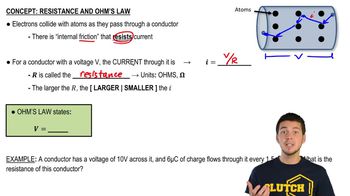
Ohm's Law
 03:07
03:07
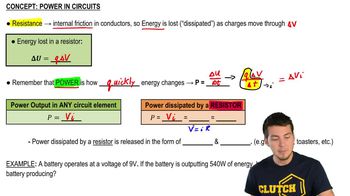
Power in Electrical Circuits
 06:18
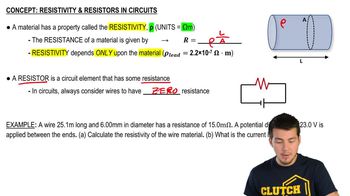
06:18Resistance Calculation
 05:25
05:25A 100-W, 120-V incandescent lightbulb has a resistance of 12 Ω when cold (20°C) and 150 Ω when on (hot). Calculate its power consumption (a) at the instant it is turned on, and (b) after a few moments when it is hot.
Household wiring has sometimes used aluminium instead of copper.Typical copper wire used for home wiring in the U.S. has a diameter of 1.63 mm. What is the resistance of 125 m of this wire?
Lightbulb A is rated at 120 V and 40 W for household applications. Lightbulb B is rated at 12 V and 40 W for automotive applications. What is the current through each bulb?
Suppose a current is given by the equation I = 1.40 sin 210t, where I is in amperes and t in seconds. What is the rms value of the current?
Copper wire of diameter 0.259 cm is used to connect a set of appliances at 120 V, which draw 1250 W of power total. What power is wasted in 25.0 m of this wire?