
Ch. 29 - Electromagnetic Induction and Faraday's Law
Giancoli Douglas - Physics for Scientists and Engineers 5th edition
Giancoli Douglas5th editionPhysics for Scientists and EngineersISBN: 9780137488179Not the one you use?Change textbook
Chapter 28, Problem 65cd

A high-intensity desk lamp is rated at 35 W but requires only 12 V. It contains a transformer that converts 120-V household voltage.
(c) What is the current in the primary coil?
(d) What is the resistance of the bulb when on?

Verified step by step guidance
1
Step 1: Understand the problem. The desk lamp uses a transformer to step down the voltage from 120 V (primary coil) to 12 V (secondary coil). The lamp is rated at 35 W, which means it consumes 35 W of power. We need to calculate (c) the current in the primary coil and (d) the resistance of the bulb when it is on.
Step 2: Use the power formula to find the current in the secondary coil. The formula for power is: P = VI, where P is power, V is voltage, and I is current. Rearrange to solve for current: I = P/V. Substitute the given values for the secondary coil: P = 35 W and V = 12 V.
Step 3: Use the transformer principle to relate the primary and secondary currents. The transformer equation is: Vp/Vs = Is/Ip, where Vp and Vs are the primary and secondary voltages, and Ip and Is are the primary and secondary currents. Rearrange to solve for the primary current: Ip = (Vs/Vp)Is. Substitute the known values: Vp = 120 V, Vs = 12 V, and the secondary current calculated in Step 2.
Step 4: To find the resistance of the bulb, use Ohm's Law: R = V/I, where R is resistance, V is voltage, and I is current. Use the secondary voltage V = 12 V and the secondary current calculated in Step 2 to find the resistance of the bulb.
Step 5: Summarize the process. First, calculate the secondary current using the power formula. Then, use the transformer equation to find the primary current. Finally, use Ohm's Law to determine the resistance of the bulb. Ensure all units are consistent throughout the calculations.

Verified video answer for a similar problem:

This video solution was recommended by our tutors as helpful for the problem above.
Video duration:
3m
Was this helpful?

Key Concepts

Here are the essential concepts you must grasp in order to answer the question correctly.

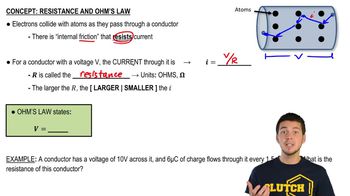
Ohm's Law

Ohm's Law states that the current (I) flowing through a conductor between two points is directly proportional to the voltage (V) across the two points and inversely proportional to the resistance (R) of the conductor. It is mathematically expressed as V = I * R. This principle is essential for calculating current and resistance in electrical circuits.
Recommended video:
Guided course
03:07
Resistance and Ohm's Law

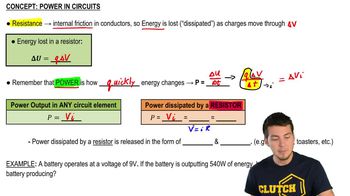
Power in Electrical Circuits

Power (P) in electrical circuits is defined as the rate at which electrical energy is consumed or converted into another form of energy. It is calculated using the formula P = V * I, where P is power in watts, V is voltage in volts, and I is current in amperes. Understanding this concept is crucial for determining the current and resistance in the given lamp scenario.
Recommended video:
Guided course
06:18
Power in Circuits

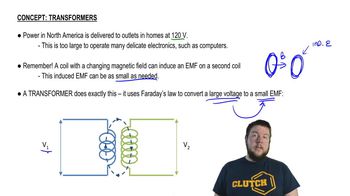
Transformers

Transformers are electrical devices that transfer electrical energy between two or more circuits through electromagnetic induction. They can step up or step down voltage levels while conserving power. In this context, the transformer converts the higher household voltage (120 V) to the lower voltage (12 V) required by the lamp, which is key to solving for the current in the primary coil.
Recommended video:
Related Practice
Textbook Question

The primary windings of a transformer which has an 85% efficiency are connected to 110-V ac. The secondary windings are connected across a 2.4-Ω, 75-W lightbulb.

(a) Calculate the current through the primary windings of the transformer.

(b) Calculate the ratio of the number of primary windings of the transformer to the number of secondary windings of the transformer.

1
views
Textbook Question

What is the energy dissipated as a function of time in a circular loop of 18 turns of wire having a radius of 10.0 cm and a resistance of 2.0 Ω if the plane of the loop is perpendicular to a magnetic field given by B(t) = B₀e⁻ᵗ/ʳ with B₀ = 0.50 T and τ = 0.10 s?

1
views
Textbook Question

Apply Faraday’s law, in the form of Eq. 29–8, to show that the static electric field between the plates of a parallel-plate capacitor cannot drop abruptly to zero at the edges, but must, in fact, fringe. Use the path shown dashed in Fig. 29–61. [Hint: Assume the contrary: that there is no fringing. Show that this assumption leads to a contradiction.]

1
views
Textbook Question

A circular loop of area 12 m² encloses a magnetic field perpendicular to the plane of the loop; its magnitude is B(t) = (8.0 T/s)t. The loop is connected to a 7.5-Ω resistor and a 6.5-pF capacitor in series. When fully charged, how much charge is stored on the capacitor?

1
views
Textbook Question

Determine the magnetic field at a point P due to a very long wire with a square bend as shown in Fig. 28–63. The point P is halfway between the two corners.

1
views
Textbook Question

A high-intensity desk lamp is rated at 35 W but requires only 12 V. It contains a transformer that converts 120-V household voltage.

(a) Is the transformer step-up or step-down?

(b) What is the current in the secondary coil when the lamp is on?

1
views