Ch. 29 - Electromagnetic Induction and Faraday's Law
Giancoli Douglas - Physics for Scientists and Engineers 5th edition
Giancoli Douglas5th editionPhysics for Scientists and EngineersISBN: 9780137488179Not the one you use?Change textbook
Chapter 28, Problem 67

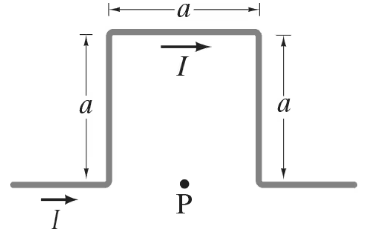
Determine the magnetic field at a point P due to a very long wire with a square bend as shown in Fig. 28–63. The point P is halfway between the two corners.

Verified step by step guidance
1
Step 1: Understand the problem setup. The magnetic field at point P is due to the current flowing through a very long wire with a square bend. Point P is located halfway between the two corners of the square bend. The magnetic field contributions from different segments of the wire need to be calculated using the Biot-Savart law or Ampère's law.
Step 2: Break the wire into segments. The wire consists of three distinct segments: two straight vertical segments and one horizontal segment forming the square bend. Analyze the contribution of each segment to the magnetic field at point P.
Step 3: Use the Biot-Savart law for the straight vertical segments. The Biot-Savart law states that the magnetic field due to a current element is given by: B=μ0I2πr, where μ0 is the permeability of free space, I is the current, and r is the distance from the wire to point P. Calculate the magnetic field contributions from each vertical segment at point P.
Step 4: Analyze the horizontal segment. For the horizontal segment, the magnetic field at point P can be calculated using the Biot-Savart law, considering the geometry of the wire and the position of point P. Integrate the contributions of small current elements along the horizontal segment to find the net magnetic field at point P.
Step 5: Combine the contributions. Add the magnetic field contributions from all three segments vectorially, taking into account their directions. The direction of the magnetic field can be determined using the right-hand rule, which states that the magnetic field circles around the current-carrying wire in a direction given by the curl of your fingers when your thumb points in the direction of the current.

Verified video answer for a similar problem:

This video solution was recommended by our tutors as helpful for the problem above.
Video duration:
1m
Was this helpful?

Key Concepts

Here are the essential concepts you must grasp in order to answer the question correctly.

Biot-Savart Law

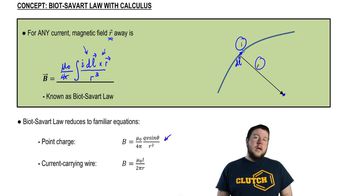
The Biot-Savart Law describes how electric currents produce magnetic fields. It states that the magnetic field dB at a point in space due to a small segment of current-carrying wire is directly proportional to the current and inversely proportional to the square of the distance from the wire segment to the point. This law is essential for calculating the magnetic field generated by complex wire configurations, such as the long wire with a bend in this question.
Recommended video:
Guided course
04:53
Biot-Savart Law with Calculus

Magnetic Field Due to a Straight Wire

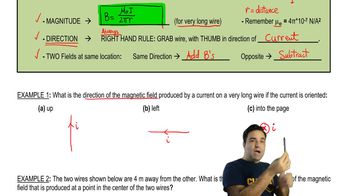
The magnetic field around a long, straight current-carrying wire can be determined using the right-hand rule and is given by the formula B = (μ₀I)/(2πr), where B is the magnetic field, μ₀ is the permeability of free space, I is the current, and r is the distance from the wire. Understanding this concept is crucial for analyzing the contributions to the magnetic field at point P from different segments of the wire.
Recommended video:
Guided course
12:33
Magnetic Field Produced by Straight Currents

Superposition Principle

The superposition principle states that the total magnetic field at a point due to multiple sources is the vector sum of the magnetic fields produced by each source independently. In the context of the wire with a square bend, this principle allows us to calculate the net magnetic field at point P by considering the contributions from each straight segment of the wire separately and then combining them.
Recommended video:
Guided course
03:32
Superposition of Sinusoidal Wave Functions
Related Practice
Textbook Question

The primary windings of a transformer which has an 85% efficiency are connected to 110-V ac. The secondary windings are connected across a 2.4-Ω, 75-W lightbulb.

(a) Calculate the current through the primary windings of the transformer.

(b) Calculate the ratio of the number of primary windings of the transformer to the number of secondary windings of the transformer.

1
views
Textbook Question

In a certain region of space near Earth’s surface, a uniform horizontal magnetic field of magnitude B exists above a level defined to be y = 0. Below y = 0, the field abruptly becomes zero (Fig. 29–63). A vertical square wire loop has resistivity ρ, mass density ρm, diameter d, and side length ℓ. It is initially at rest with its lower horizontal side at y = 0 and is then allowed to fall under gravity, with its plane perpendicular to the direction of the magnetic field. (a) While the loop is still partially immersed in the magnetic field (as it falls into the zero-field region), determine the magnetic “drag” force that acts on it at the moment when its speed is υ. (b) Assume that the loop achieves a constant terminal velocity VT before its upper horizontal side exits the field. Determine a formula for VT. (c) If the loop is made of copper and B = 0.80 T, find VT.

1
views
Textbook Question

What is the energy dissipated as a function of time in a circular loop of 18 turns of wire having a radius of 10.0 cm and a resistance of 2.0 Ω if the plane of the loop is perpendicular to a magnetic field given by B(t) = B₀e⁻ᵗ/ʳ with B₀ = 0.50 T and τ = 0.10 s?

1
views
Textbook Question

Apply Faraday’s law, in the form of Eq. 29–8, to show that the static electric field between the plates of a parallel-plate capacitor cannot drop abruptly to zero at the edges, but must, in fact, fringe. Use the path shown dashed in Fig. 29–61. [Hint: Assume the contrary: that there is no fringing. Show that this assumption leads to a contradiction.]

1
views
Textbook Question

A high-intensity desk lamp is rated at 35 W but requires only 12 V. It contains a transformer that converts 120-V household voltage.

(c) What is the current in the primary coil?

(d) What is the resistance of the bulb when on?

1
views
Textbook Question

A high-intensity desk lamp is rated at 35 W but requires only 12 V. It contains a transformer that converts 120-V household voltage.

(a) Is the transformer step-up or step-down?

(b) What is the current in the secondary coil when the lamp is on?

1
views