
Ch. 29 - Electromagnetic Induction and Faraday's Law
Giancoli Douglas - Physics for Scientists and Engineers 5th edition
Giancoli Douglas5th editionPhysics for Scientists and EngineersISBN: 9780137488179Not the one you use?Change textbook
Chapter 28, Problem 61

A circular loop of area 12 m² encloses a magnetic field perpendicular to the plane of the loop; its magnitude is B(t) = (8.0 T/s)t. The loop is connected to a 7.5-Ω resistor and a 6.5-pF capacitor in series. When fully charged, how much charge is stored on the capacitor?

Verified step by step guidance
1
Determine the electromotive force (EMF) induced in the loop using Faraday's Law of Induction. Faraday's Law states that the EMF is given by \( \text{EMF} = -\frac{d\Phi_B}{dt} \), where \( \Phi_B \) is the magnetic flux. The magnetic flux is \( \Phi_B = B(t) \cdot A \), where \( B(t) = (8.0 \ \text{T/s})t \) and \( A = 12 \ \text{m}^2 \). Differentiate \( \Phi_B \) with respect to time to find \( \text{EMF} \).
Calculate the current in the circuit using Ohm's Law. The current is given by \( I = \frac{\text{EMF}}{R} \), where \( R = 7.5 \ \Omega \) is the resistance of the resistor. Substitute the expression for \( \text{EMF} \) from the previous step to find \( I \) as a function of time.
Determine the voltage across the capacitor. In a series circuit, the voltage across the capacitor is equal to the EMF minus the voltage drop across the resistor. Use \( V_C = \text{EMF} - I \cdot R \). Substitute the expressions for \( \text{EMF} \) and \( I \) to find \( V_C \) as a function of time.
Relate the charge on the capacitor to the voltage across it. The charge \( Q \) on a capacitor is given by \( Q = C \cdot V_C \), where \( C = 6.5 \ \text{pF} = 6.5 \times 10^{-12} \ \text{F} \). Substitute the expression for \( V_C \) to find \( Q \) as a function of time.
Find the maximum charge stored on the capacitor. The capacitor will be fully charged when the current in the circuit becomes zero, which happens when the voltage across the capacitor equals the EMF. Set \( V_C = \text{EMF} \) and solve for \( Q \) using \( Q = C \cdot \text{EMF} \).

Verified video answer for a similar problem:

This video solution was recommended by our tutors as helpful for the problem above.
Video duration:
7m
Was this helpful?

Key Concepts

Here are the essential concepts you must grasp in order to answer the question correctly.

Faraday's Law of Electromagnetic Induction

Faraday's Law states that a change in magnetic flux through a loop induces an electromotive force (EMF) in the loop. The induced EMF is proportional to the rate of change of the magnetic flux, which can be calculated using the formula EMF = -dΦ/dt, where Φ is the magnetic flux. In this scenario, the changing magnetic field B(t) leads to a time-varying flux, which is crucial for determining the induced EMF in the loop.
Recommended video:
Guided course
09:26
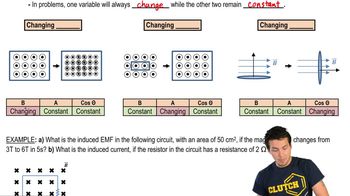
Faraday's Law

Capacitance and Charge Storage

Capacitance is the ability of a capacitor to store charge per unit voltage, defined by the formula C = Q/V, where C is capacitance, Q is charge, and V is voltage. In this problem, the capacitor's capacitance is given as 6.5 pF. Once the capacitor is fully charged, the charge stored can be calculated using the induced EMF from Faraday's Law, which provides the voltage across the capacitor.
Recommended video:
Guided course
08:02
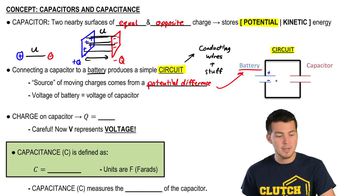
Capacitors & Capacitance (Intro)

Series Circuit Behavior

In a series circuit, the same current flows through all components, and the total voltage across the circuit is the sum of the voltages across each component. The resistor and capacitor in this problem are in series, meaning the total voltage induced by the changing magnetic field will be divided between the resistor and the capacitor. The relationship between voltage, current, and resistance (Ohm's Law) is essential for calculating the current flowing through the circuit, which ultimately determines the charge on the capacitor.
Recommended video:
Guided course
05:55
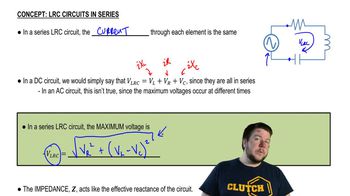
LRC Circuits in Series
Related Practice
Textbook Question

If 75 MW of power at 45 kV (rms) arrives at a town from a generator via transmission lines of total resistance 3.0 Ω, calculate (a) the emf at the generator end of the lines, and (b) the fraction of the power generated that is wasted in the lines.

1
views
Textbook Question

The primary windings of a transformer which has an 85% efficiency are connected to 110-V ac. The secondary windings are connected across a 2.4-Ω, 75-W lightbulb.

(a) Calculate the current through the primary windings of the transformer.

(b) Calculate the ratio of the number of primary windings of the transformer to the number of secondary windings of the transformer.

1
views
Textbook Question

(II) For the electric power transmission system shown in Fig. 29–26, what is the ratio Ns/Np for (a) the step-up transformer, (b) the step-down transformer next to the home?

1
views
Textbook Question

(III) In a circular region, there is a uniform magnetic field B\(\overrightarrow{B}\) pointing into the page (Fig. 29–56). An xy coordinate system has its origin at the circular region’s center. A free positive point charge +Q = 1.0 μC is initially at rest at a position x = +10 cm on the x axis. If the magnitude of the magnetic field is now decreased at a rate of -0.10 T/s, what force (magnitude and direction) will act on +Q?


1
views
Textbook Question

A high-intensity desk lamp is rated at 35 W but requires only 12 V. It contains a transformer that converts 120-V household voltage.

(c) What is the current in the primary coil?

(d) What is the resistance of the bulb when on?

1
views
Textbook Question

A high-intensity desk lamp is rated at 35 W but requires only 12 V. It contains a transformer that converts 120-V household voltage.

(a) Is the transformer step-up or step-down?

(b) What is the current in the secondary coil when the lamp is on?

1
views