Ch 13: Newton's Theory of Gravity
Knight Calc - Physics for Scientists and Engineers 5th Edition
Knight Calc5th EditionPhysics for Scientists and EngineersISBN: 9780137344796Not the one you use?Change textbook
Chapter 13, Problem 62

A 55,000 kg space capsule is in a 28,000-km-diameter circular orbit around the moon. A brief but intense firing of its engine in the forward direction suddenly decreases its speed by 50%. This causes the space capsule to go into an elliptical orbit. What are the space capsule’s (a) maximum and (b) minimum distances from the center of the moon in its new orbit? Hint: You will need to use two conservation laws.

Verified step by step guidance
1
Step 1: Identify the given values and understand the problem. The mass of the space capsule is 55,000 kg, the initial orbit is circular with a diameter of 28,000 km (radius = 14,000 km), and the speed decreases by 50%. The problem involves transitioning from a circular orbit to an elliptical orbit, requiring the use of conservation of energy and conservation of angular momentum.
Step 2: Apply the conservation of angular momentum. Angular momentum is conserved because no external torque acts on the system. The initial angular momentum in the circular orbit is given by \( L_{initial} = m v_{initial} r \), where \( m \) is the mass, \( v_{initial} \) is the initial orbital speed, and \( r \) is the radius of the circular orbit. After the speed decreases, the angular momentum is \( L_{final} = m v_{final} r_{periapsis} \). Set \( L_{initial} = L_{final} \) to relate the periapsis distance \( r_{periapsis} \) to the initial conditions.
Step 3: Use the conservation of mechanical energy. The total mechanical energy in the orbit is the sum of kinetic energy and gravitational potential energy. For the initial circular orbit, \( E_{initial} = \frac{1}{2} m v_{initial}^2 - \frac{G M m}{r} \), where \( G \) is the gravitational constant, \( M \) is the mass of the moon, and \( r \) is the radius of the circular orbit. For the elliptical orbit, \( E_{final} = \frac{1}{2} m v_{final}^2 - \frac{G M m}{r_{periapsis}} \). Set \( E_{initial} = E_{final} \) to find the relationship between the periapsis and apoapsis distances.
Step 4: Relate the apoapsis and periapsis distances to the semi-major axis of the elliptical orbit. The semi-major axis \( a \) is given by \( a = \frac{r_{periapsis} + r_{apoapsis}}{2} \). Use the energy and angular momentum equations to solve for \( r_{periapsis} \) and \( r_{apoapsis} \). The apoapsis distance \( r_{apoapsis} \) is the farthest point from the moon, and the periapsis distance \( r_{periapsis} \) is the closest point.
Step 5: Solve the equations step by step. First, calculate the initial orbital speed \( v_{initial} \) using \( v_{initial} = \sqrt{\frac{G M}{r}} \). Then, find \( v_{final} = 0.5 v_{initial} \). Substitute \( v_{initial} \) and \( v_{final} \) into the angular momentum and energy conservation equations to solve for \( r_{periapsis} \) and \( r_{apoapsis} \). These distances represent the maximum and minimum distances from the center of the moon in the new elliptical orbit.

Verified video answer for a similar problem:

This video solution was recommended by our tutors as helpful for the problem above.
Video duration:
14m
Was this helpful?

Key Concepts

Here are the essential concepts you must grasp in order to answer the question correctly.

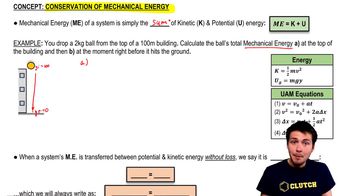
Conservation of Energy

The conservation of energy principle states that the total energy in a closed system remains constant over time. In the context of orbital mechanics, this means that the sum of kinetic and potential energy of the space capsule must remain constant before and after the engine firing. When the capsule's speed decreases, its kinetic energy decreases, which must be compensated by a change in potential energy as it moves to a new elliptical orbit.
Recommended video:
Guided course
06:24
Conservation Of Mechanical Energy

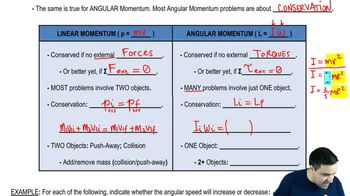
Conservation of Angular Momentum

Angular momentum conservation is a fundamental principle stating that if no external torque acts on a system, its angular momentum remains constant. For the space capsule, this means that the product of its mass, velocity, and distance from the center of the moon must remain unchanged during the transition from a circular to an elliptical orbit. This concept is crucial for determining the new distances from the moon's center after the speed change.
Recommended video:
Guided course
12:12
Conservation of Angular Momentum

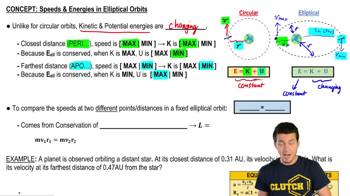
Elliptical Orbits

Elliptical orbits are paths followed by objects in space that are shaped like elongated circles. In the case of the space capsule, after the speed reduction, it transitions from a circular orbit to an elliptical one, characterized by a periapsis (closest point to the moon) and an apoapsis (farthest point). Understanding the properties of elliptical orbits, including how they relate to energy and angular momentum, is essential for calculating the maximum and minimum distances from the moon's center.
Recommended video:
Guided course
6:03
Speed and Energy of Elliptical Orbits
Related Practice
Textbook Question

Two Jupiter-size planets are released from rest 1.0 x 10¹¹ m apart. What are their speeds as they crash together?

3
views

Textbook Question

Comets move around the sun in very elliptical orbits. At its closet approach, in 1986, Comet Halley was 8.79 x 10⁷ km from the sun and moving with a speed of 54.6 km/s. What was the comet’s speed when it crossed Neptune’s orbit in 2006?

Textbook Question

Three stars, each with the mass of our sun, form an equilateral triangle with sides 1.0 x 10¹² m long. (This triangle would just about fit within the orbit of Jupiter.) The triangle has to rotate, because otherwise the stars would crash together in the center. What is the period of rotation?

1
views
Textbook Question

While visiting Planet Physics, you toss a rock straight up at 11 m/s and catch it 2.5 s later. While you visit the surface, your cruise ship orbits at an altitude equal to the planet's radius every 230 min. What are the (a) mass and (b) radius of Planet Physics?

1
views
Textbook Question

A satellite in a circular orbit of radius r has period T. A satellite in a nearby orbit with radius r + Δr, where Δr ≪ r, has the very slightly different period T + ΔT. Show that ΔT/T = (3/2) (Δr/r)

1
views
Textbook Question

The solar system is 25,000 light years from the center of our Milky Way galaxy. One light year is the distance light travels in one year at a speed of 3.0 x 10⁸ m/s. Astronomers have determined that the solar system is orbiting the center of the galaxy at a speed of 230 km/s. Assume that the sun is a typical star with a typical mass. If galactic matter is made up of stars, approximately how many stars are in the center of the galaxy?

1
views