

Ch. 34 - The Wave Nature of Light: Interference and Polarization
Giancoli Douglas - Physics for Scientists and Engineers 5th edition
Giancoli Douglas5th editionPhysics for Scientists and EngineersISBN: 9780137488179Not the one you use?Change textbook
Chapter 33, Problem 69

Light of wavelength 690 nm passes through two narrow slits 0.66 mm apart. The screen is 1.75 m away. A second source of unknown wavelength produces its second-order fringe 1.23 mm closer to the central maximum than the 690-nm light. What is the wavelength of the unknown light?

Verified step by step guidance
1
Identify the given values for the first light source: wavelength \\(\lambda_1 = 690 \\, \text{nm}\\), slit separation \\(\text{d} = 0.66 \\, \text{mm}\\), and distance to the screen \\(\text{L} = 1.75 \\, \text{m}\\).
Use the formula for the position of the m-th order bright fringe for a double-slit interference pattern: \\(\text{y}_m = \frac{m \lambda L}{d}\\), where \\(\text{y}_m\\) is the fringe position, \\(\text{m}\\) is the order of the fringe, \\(\lambda\\) is the wavelength, \\(\text{L}\\) is the distance to the screen, and \\(\text{d}\\) is the slit separation.
Calculate the position of the second-order (\\(\text{m} = 2\\)) bright fringe for the 690 nm light using the above formula.
For the second light source, note that its second-order fringe is 1.23 mm closer to the central maximum than that of the 690 nm light. Let \\(\lambda_2\\) be the wavelength of the unknown light. Set up the equation \\(\frac{2 \lambda_2 L}{d} = \frac{2 \cdot 690 \\, \text{nm} \cdot L}{d} - 1.23 \\, \text{mm}\\) to find \\(\lambda_2\\).
Solve the equation for \\(\lambda_2\\) to find the wavelength of the unknown light.

Verified video answer for a similar problem:

This video solution was recommended by our tutors as helpful for the problem above.
Video duration:
6m
Was this helpful?

Key Concepts

Here are the essential concepts you must grasp in order to answer the question correctly.

Double-Slit Experiment

The double-slit experiment demonstrates the wave nature of light through interference patterns created when light passes through two closely spaced slits. The resulting pattern consists of alternating bright and dark fringes on a screen, which can be analyzed to determine the wavelength of the light used. The position of these fringes is influenced by the distance between the slits, the distance to the screen, and the wavelength of the light.
Recommended video:
Guided course
12:00
Young's Double Slit Experiment

Interference and Fringe Spacing

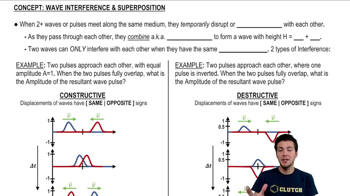
Interference occurs when two or more waves overlap, resulting in a new wave pattern. In the context of the double-slit experiment, the fringe spacing can be calculated using the formula: y = (m * λ * L) / d, where y is the fringe position, m is the order of the fringe, λ is the wavelength, L is the distance to the screen, and d is the distance between the slits. This relationship allows for the determination of unknown wavelengths based on the positions of the fringes.
Recommended video:
Guided course
03:47
Wave Interference & Superposition

Wavelength Calculation

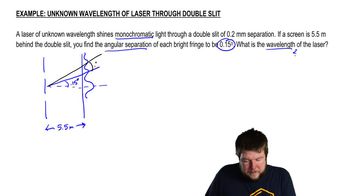
Wavelength is a fundamental property of waves, defined as the distance between successive peaks of a wave. In this problem, the difference in fringe positions for two light sources allows for the calculation of the unknown wavelength using the known wavelength and the geometry of the setup. By applying the interference conditions and the relationship between fringe positions and wavelengths, one can derive the wavelength of the unknown light source.
Recommended video:
Guided course
05:42
Unknown Wavelength of Laser through Double Slit
Related Practice
Textbook Question

Consider two antennas radiating 6.8-MHz radio waves in phase with each other. They are located at points S₁ and S₂, separated by a distance d = 175 m, Fig. 34–50. Determine the points on the positive y-axis where the signals from the two sources will be out of phase (crests of one meet troughs of the other).

1
views
Textbook Question

A highly reflective mirror can be made for a particular wavelength at normal incidence by using two thin layers of transparent materials of indices of refraction n₁ and n₂ ( 1 < n₁ < n₂ ) on the surface of the glass (n > n₂). What should be the minimum thicknesses d₁ and d₂ in Fig. 34–49 in terms of the incident wavelength λ, to maximize reflection?

1
views
Textbook Question

Light of wavelength 5.0 x 10⁻⁷ passes through two parallel slits and falls on a screen 5.0 m away. Adjacent bright bands of the interference pattern are 2.0 cm apart.

(a) Find the distance between the slits.

(b) The same two slits are next illuminated by light of a different wavelength, and the fifth minimum for this light occurs at the same point on the screen as the fourth minimum for the previous light. What is the wavelength of the second source of light?

1
views
Textbook Question

Suppose the mirrors in a Michelson interferometer are perfectly aligned and the path lengths to mirrors M₁ and M₂ are identical. With these initial conditions, an observer sees a bright maximum at the center of the viewing area. Now one of the mirrors is moved a distance x. Determine a formula for the intensity at the center of the viewing area as a function of x, the distance the movable mirror is moved from the initial position.

1
views
Textbook Question

What would Brewster’s angle be for reflections off the surface of water for light coming from beneath the surface? Compare to the angle for total internal reflection, and to Brewster’s angle from above the surface.

Textbook Question

What is Brewster’s angle for an air-glass (n = 1.56) surface? Specify two answers.

1
views