
Two narrow slits 0.070 mm apart are illuminated by a very bright 488-nm light source forming an interference pattern on a screen 4.0 m away. Calculate (a) the distance between the m = 0 and m = 1 lines in the pattern and (b) the distance between the m = 100 and m = 101 lines.
Giancoli Douglas 5th edition
Ch. 34 - The Wave Nature of Light: Interference and Polarization
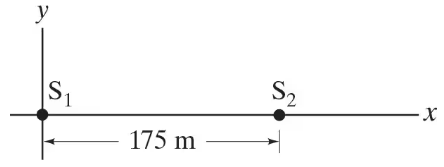
Problem 78Consider two antennas radiating 6.8-MHz radio waves in phase with each other. They are located at points S₁ and S₂, separated by a distance d = 175 m, Fig. 34–50. Determine the points on the positive y-axis where the signals from the two sources will be out of phase (crests of one meet troughs of the other).

Verified step by step guidanceKey Concepts
Wave Interference
Phase Difference
Path Length Difference
A highly reflective mirror can be made for a particular wavelength at normal incidence by using two thin layers of transparent materials of indices of refraction n₁ and n₂ ( 1 < n₁ < n₂ ) on the surface of the glass (n > n₂). What should be the minimum thicknesses d₁ and d₂ in Fig. 34–49 in terms of the incident wavelength λ, to maximize reflection?
Suppose the mirrors in a Michelson interferometer are perfectly aligned and the path lengths to mirrors M₁ and M₂ are identical. With these initial conditions, an observer sees a bright maximum at the center of the viewing area. Now one of the mirrors is moved a distance x. Determine a formula for the intensity at the center of the viewing area as a function of x, the distance the movable mirror is moved from the initial position.
Two polarizers are oriented at 55° to each other and plane-polarized light is incident on them. If only 25% of the light gets through both of them, what was the initial polarization direction of the incident light?
Light of wavelength 690 nm passes through two narrow slits 0.66 mm apart. The screen is 1.75 m away. A second source of unknown wavelength produces its second-order fringe 1.23 mm closer to the central maximum than the 690-nm light. What is the wavelength of the unknown light?
Unpolarized light falls on two polarizer sheets whose axes are at right angles. (a) What fraction of the incident light intensity is transmitted? (b) What fraction is transmitted if a third polarizer is placed between the first two so that its axis makes a 58° angle with the axis of the first polarizer? (c) What if the third polarizer is in front of the other two?