
Ch. 34 - The Wave Nature of Light: Interference and Polarization
Giancoli Douglas - Physics for Scientists and Engineers 5th edition
Giancoli Douglas5th editionPhysics for Scientists and EngineersISBN: 9780137488179Not the one you use?Change textbook
Chapter 33, Problem 54

What would Brewster’s angle be for reflections off the surface of water for light coming from beneath the surface? Compare to the angle for total internal reflection, and to Brewster’s angle from above the surface.

Verified step by step guidance
1
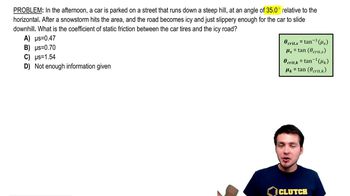
Determine Brewster's angle using the formula: tan(θB) = n2 / n1, where n1 is the refractive index of the medium the light is coming from (water in this case) and n2 is the refractive index of the medium the light is entering (air).
Rearrange the formula to solve for Brewster's angle: θB = arctan(n2 / n1). Substitute the refractive indices of water (n1 ≈ 1.33) and air (n2 ≈ 1.00).
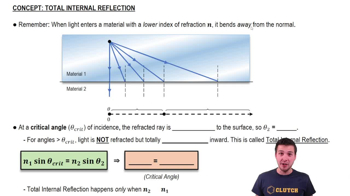
Compare this Brewster's angle to the critical angle for total internal reflection. Use the formula for the critical angle: θc = arcsin(n2 / n1). Substitute the same refractive indices to calculate the critical angle.
Now, consider Brewster's angle for light coming from above the surface (air to water). Use the same formula for Brewster's angle: θB = arctan(n2 / n1), but this time n1 = 1.00 (air) and n2 = 1.33 (water).
Compare the Brewster's angles for light coming from beneath the surface and from above the surface, as well as the critical angle for total internal reflection. Discuss how these angles relate to the behavior of light at the water-air interface.

Verified video answer for a similar problem:

This video solution was recommended by our tutors as helpful for the problem above.
Video duration:
5m
Was this helpful?

Key Concepts

Here are the essential concepts you must grasp in order to answer the question correctly.

Brewster's Angle

Brewster's angle is the angle of incidence at which light with a particular polarization is perfectly transmitted through a transparent dielectric surface, with no reflection. It can be calculated using the formula θ_B = arctan(n2/n1), where n1 and n2 are the refractive indices of the two media. At this angle, the reflected and refracted rays are perpendicular to each other.
Recommended video:
Guided course
01:04
Critical Angle

Total Internal Reflection

Total internal reflection occurs when a light wave traveling in a denser medium hits a boundary with a less dense medium at an angle greater than the critical angle. Instead of refracting, the light is completely reflected back into the denser medium. This phenomenon is crucial in fiber optics and occurs only when the light is moving from a medium with a higher refractive index to one with a lower refractive index.
Recommended video:
Guided course
05:29
Total Internal Reflection

Refractive Index

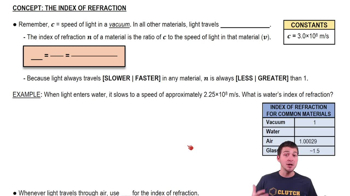
The refractive index is a dimensionless number that describes how light propagates through a medium. It is defined as the ratio of the speed of light in a vacuum to the speed of light in the medium. The refractive index affects how much light bends when entering or exiting a medium, influencing both Brewster's angle and the conditions for total internal reflection.
Recommended video:
Guided course
03:46
Index of Refraction
Related Practice
Textbook Question

Light of wavelength 5.0 x 10⁻⁷ passes through two parallel slits and falls on a screen 5.0 m away. Adjacent bright bands of the interference pattern are 2.0 cm apart.

(a) Find the distance between the slits.

(b) The same two slits are next illuminated by light of a different wavelength, and the fifth minimum for this light occurs at the same point on the screen as the fourth minimum for the previous light. What is the wavelength of the second source of light?

1
views
Textbook Question

A single optical coating reduces reflection to zero for λ = 550 nm. By what factor is the intensity reduced by the coating for λ = 430 nm and λ = 670 nm as compared to no coating? Assume normal incidence.

1
views
Textbook Question

Suppose the mirrors in a Michelson interferometer are perfectly aligned and the path lengths to mirrors M₁ and M₂ are identical. With these initial conditions, an observer sees a bright maximum at the center of the viewing area. Now one of the mirrors is moved a distance x. Determine a formula for the intensity at the center of the viewing area as a function of x, the distance the movable mirror is moved from the initial position.

1
views
Textbook Question

Light of wavelength 690 nm passes through two narrow slits 0.66 mm apart. The screen is 1.75 m away. A second source of unknown wavelength produces its second-order fringe 1.23 mm closer to the central maximum than the 690-nm light. What is the wavelength of the unknown light?

1
views
Textbook Question

What is Brewster’s angle for an air-glass (n = 1.56) surface? Specify two answers.

1
views
Textbook Question

(II) When a Newton’s ring apparatus (Fig. 34–18) is immersed in a liquid, the diameter of the tenth dark ring decreases from 2.92 cm to 2.54 cm. What is the refractive index of the liquid? [Hint: See Problem 37.]

1
views