Ch. 34 - The Wave Nature of Light: Interference and Polarization
Giancoli Douglas - Physics for Scientists and Engineers 5th edition
Giancoli Douglas5th editionPhysics for Scientists and EngineersISBN: 9780137488179Not the one you use?Change textbook
Chapter 33, Problem 39

(II) When a Newton’s ring apparatus (Fig. 34–18) is immersed in a liquid, the diameter of the tenth dark ring decreases from 2.92 cm to 2.54 cm. What is the refractive index of the liquid? [Hint: See Problem 37.]

Verified step by step guidance
1
Step 1: Understand the concept of Newton's rings. Newton's rings are formed due to the interference of light reflected from the top and bottom surfaces of a thin air film between a lens and a glass plate. The diameter of the rings depends on the wavelength of light and the refractive index of the medium.
Step 2: Recall the formula for the diameter of the nth dark ring in Newton's rings: \( D_n = \sqrt{4nR\lambda} \), where \( D_n \) is the diameter of the nth dark ring, \( n \) is the ring number, \( R \) is the radius of curvature of the lens, and \( \lambda \) is the wavelength of light in the medium. When the apparatus is immersed in a liquid, the wavelength changes due to the refractive index of the liquid.
Step 3: Use the relationship between the wavelength in air and the wavelength in the liquid: \( \lambda_{liquid} = \frac{\lambda_{air}}{n_{liquid}} \), where \( n_{liquid} \) is the refractive index of the liquid. This affects the diameter of the rings.
Step 4: Set up the ratio of the diameters of the tenth dark ring before and after immersion in the liquid: \( \frac{D_{air}}{D_{liquid}} = \sqrt{n_{liquid}} \). Substitute the given values for \( D_{air} = 2.92 \, \text{cm} \) and \( D_{liquid} = 2.54 \, \text{cm} \).
Step 5: Solve for \( n_{liquid} \) using the formula \( n_{liquid} = \left( \frac{D_{air}}{D_{liquid}} \right)^2 \). This will give the refractive index of the liquid.

Verified video answer for a similar problem:

This video solution was recommended by our tutors as helpful for the problem above.
Video duration:
4m
Was this helpful?

Key Concepts

Here are the essential concepts you must grasp in order to answer the question correctly.

Newton's Rings

Newton's rings are a pattern of concentric circles created by the interference of light waves reflected between a spherical surface and a flat glass plate. The dark and bright rings result from constructive and destructive interference, which depends on the wavelength of light and the radius of curvature of the lens. The diameter of these rings changes when the medium between the lens and the plate is altered, such as when immersed in a liquid.
Recommended video:
Guided course
04:27
Magnetic Flux of a Rotating Ring

Refractive Index

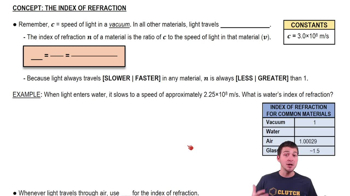
The refractive index is a dimensionless number that describes how light propagates through a medium. It is defined as the ratio of the speed of light in a vacuum to the speed of light in the medium. A higher refractive index indicates that light travels slower in that medium, which affects the interference patterns observed in experiments like Newton's rings, allowing for the calculation of the refractive index based on changes in ring diameters.
Recommended video:
Guided course
03:46
Index of Refraction

Interference of Light

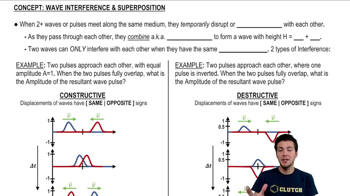
Interference of light occurs when two or more light waves overlap and combine, resulting in a new wave pattern. This phenomenon can lead to regions of constructive interference (bright spots) and destructive interference (dark spots). In the context of Newton's rings, the interference pattern is influenced by the thickness of the air or liquid layer between the lens and the plate, which changes as the medium is altered, thus affecting the observed ring diameters.
Recommended video:
Guided course
03:47
Wave Interference & Superposition