Ch. 08 - Conservation of Energy
Giancoli Douglas - Physics for Scientists and Engineers 5th edition
Giancoli Douglas5th editionPhysics for Scientists and EngineersISBN: 9780137488179Not the one you use?Change textbook
Chapter 8, Problem 2

You drop a basketball from a height of 5.0 m, which rebounds to a new height of 3.0 m. How much energy is lost to nonconservative forces? Give your answer as percentage of the initial energy.

Verified step by step guidance
1
Determine the initial potential energy of the basketball at the height of 5.0 m using the formula: Eip = mgh, where m is the mass of the basketball, g is the acceleration due to gravity (9.8 m/s²), and h is the initial height (5.0 m).
Calculate the potential energy of the basketball at the rebound height of 3.0 m using the same formula: Efp = mgh, where h is now 3.0 m.
Find the energy lost to nonconservative forces by subtracting the final potential energy from the initial potential energy: Elost = Eip - Efp.
Express the energy lost as a percentage of the initial energy using the formula: Percentage = (Elost / Eip) × 100.
Substitute the known values into the formulas and simplify to find the percentage of energy lost to nonconservative forces.

Verified video answer for a similar problem:

This video solution was recommended by our tutors as helpful for the problem above.
Video duration:
5m
Was this helpful?

Key Concepts

Here are the essential concepts you must grasp in order to answer the question correctly.

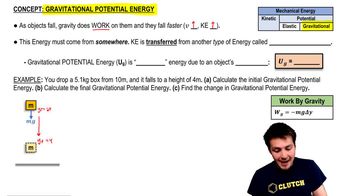
Gravitational Potential Energy

Gravitational potential energy (PE) is the energy an object possesses due to its position in a gravitational field. It is calculated using the formula PE = mgh, where m is mass, g is the acceleration due to gravity, and h is the height above a reference point. In this scenario, the initial potential energy of the basketball when dropped from 5.0 m can be compared to its potential energy at the rebound height of 3.0 m.
Recommended video:
Guided course
06:35
Gravitational Potential Energy

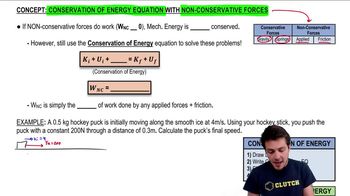
Energy Conservation and Nonconservative Forces

The principle of conservation of energy states that energy cannot be created or destroyed, only transformed from one form to another. In this case, some energy is lost to nonconservative forces, such as air resistance and internal friction, which dissipate mechanical energy as heat or sound. The difference in potential energy before and after the bounce indicates the energy lost to these nonconservative forces.
Recommended video:
Guided course
06:43
Energy Conservation with Non-Conservative Forces

Percentage Energy Loss

To determine the percentage of energy lost, one must calculate the initial and final potential energies and find the difference. The energy lost can then be expressed as a percentage of the initial energy using the formula: (Energy Lost / Initial Energy) × 100%. This calculation provides insight into the efficiency of the energy transfer during the bounce of the basketball.
Recommended video:
Guided course
03:55
Energy Released by Flashbulb