
Ch 11: Impulse and Momentum
Knight Calc - Physics for Scientists and Engineers 5th Edition
Knight Calc5th EditionPhysics for Scientists and EngineersISBN: 9780137344796Not the one you use?Change textbook
Chapter 11, Problem 85b

A rocket with a total mass of 330,000 kg when fully loaded burns all 280,000 kg of fuel in 250 s. The engines generate 4.1 MN of thrust. What is this rocket's speed at the instant all the fuel has been burned if it is launched in deep space? If it is launched vertically from the earth?

Verified step by step guidance
1
Step 1: Recognize that this problem involves the application of the Tsiolkovsky rocket equation, which relates the change in velocity of a rocket to the exhaust velocity, the initial mass, and the final mass. The equation is: Δv = ve ln(mi/mf), where ve is the effective exhaust velocity, mi is the initial mass, and mf is the final mass.
Step 2: Calculate the effective exhaust velocity ve using the thrust equation: F = ve dm/dt. Here, F is the thrust (4.1 MN), and dm/dt is the rate of fuel consumption, which can be calculated as dm/dt = mfuel/t (280,000 kg / 250 s).
Step 3: Substitute the values of ve, mi (330,000 kg), and mf (330,000 kg - 280,000 kg) into the Tsiolkovsky rocket equation to calculate the change in velocity Δv for the rocket in deep space.
Step 4: For the case of vertical launch from Earth, account for the gravitational force acting on the rocket. The net acceleration is reduced by the gravitational acceleration g = 9.8 m/s². Modify the thrust equation to include this effect: F - mig = mia, where a is the net acceleration.
Step 5: Integrate the net acceleration over the burn time (250 s) to find the velocity of the rocket when launched vertically from Earth. Use the relationship v = at, where a is the net acceleration calculated in Step 4.

Verified video answer for a similar problem:

This video solution was recommended by our tutors as helpful for the problem above.
Was this helpful?

Key Concepts

Here are the essential concepts you must grasp in order to answer the question correctly.

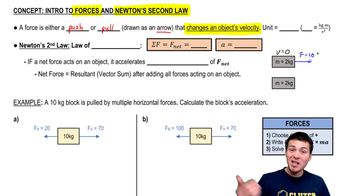
Thrust and Newton's Second Law

Thrust is the force exerted by the rocket engines to propel the rocket forward. According to Newton's Second Law, the acceleration of an object is directly proportional to the net force acting on it and inversely proportional to its mass (F = ma). This principle is crucial for understanding how the rocket's thrust affects its motion and speed.
Recommended video:
Guided course
06:54
Intro to Forces & Newton's Second Law

Rocket Equation (Tsiolkovsky's Rocket Equation)

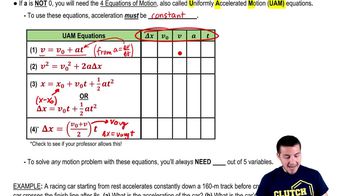
The Tsiolkovsky Rocket Equation relates the velocity of a rocket to its mass and the effective exhaust velocity of the propellant. It is expressed as Δv = ve * ln(m0/mf), where Δv is the change in velocity, ve is the effective exhaust velocity, m0 is the initial mass, and mf is the final mass after fuel is burned. This equation is essential for calculating the speed of the rocket after all fuel has been consumed.
Recommended video:
Guided course
08:25
Kinematics Equations

Gravitational Force and Escape Velocity

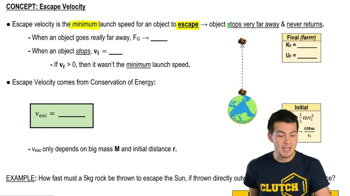
When launching from Earth, the rocket must overcome gravitational force, which affects its acceleration and speed. The escape velocity is the minimum speed needed to break free from Earth's gravitational pull without further propulsion. Understanding the difference in conditions for launching in deep space versus from Earth is vital for accurately determining the rocket's final speed.
Recommended video:
Guided course
7:27
Escape Velocity