Ch 11: Impulse and Momentum
Knight Calc - Physics for Scientists and Engineers 5th Edition
Knight Calc5th EditionPhysics for Scientists and EngineersISBN: 9780137344796Not the one you use?Change textbook
Chapter 11, Problem 80

A spaceship of mass 2.0×10⁶ kg is cruising at a speed of 5.0×10⁶ m/s when the antimatter reactor fails, blowing the ship into three pieces. One section, having a mass of 5.0×10⁵ kg, is blown straight backward with a speed of 2.0×10⁶ m/s . A second piece, with mass 8.0×10⁵ kg, continues forward at 1.0×10⁶ m/s. What are the direction and speed of the third piece?

Verified step by step guidance
1
Step 1: Identify the principle of conservation of momentum. The total momentum of the system before the explosion must equal the total momentum of the system after the explosion, as no external forces are acting on the spaceship.
Step 2: Calculate the total momentum of the spaceship before the explosion. Use the formula for momentum: p=mv, where m is the mass and v is the velocity. Here, m=2.0×10⁶ kg and v=5.0×10⁶ m/s.
Step 3: Calculate the momentum of the first piece after the explosion. Use the same formula p=mv, where m=5.0×10⁵ kg and v=-2.0×10⁶ m/s (negative because it is moving backward).
Step 4: Calculate the momentum of the second piece after the explosion. Again, use p=mv, where m=8.0×10⁵ kg and v=1.0×10⁶ m/s.
Step 5: Use the conservation of momentum to find the momentum of the third piece. Subtract the total momentum of the first and second pieces from the initial momentum of the spaceship. Then, solve for the velocity of the third piece using v=p/m, where m is the mass of the third piece, which can be found by subtracting the masses of the first and second pieces from the total mass of the spaceship.

Verified video answer for a similar problem:

This video solution was recommended by our tutors as helpful for the problem above.
Was this helpful?

Key Concepts

Here are the essential concepts you must grasp in order to answer the question correctly.

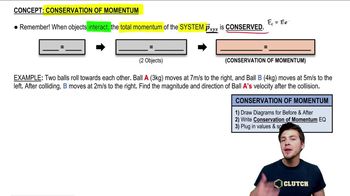
Conservation of Momentum

The principle of conservation of momentum states that in a closed system, the total momentum before an event must equal the total momentum after the event, provided no external forces act on it. In this scenario, the momentum of the spaceship before the explosion must equal the combined momentum of the three pieces after the explosion, allowing us to solve for the unknown piece.
Recommended video:
Guided course
05:58
Conservation Of Momentum

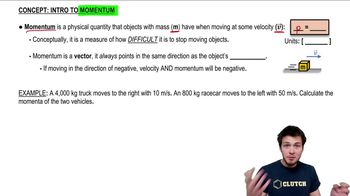
Momentum Calculation

Momentum is calculated as the product of an object's mass and its velocity (p = mv). For each piece of the spaceship, we can calculate its momentum before and after the explosion. This calculation is essential for determining the speed and direction of the third piece by ensuring that the total momentum is conserved.
Recommended video:
Guided course
05:17
Intro to Momentum

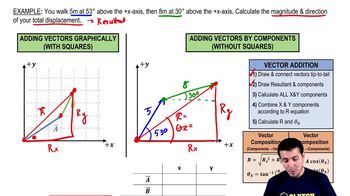
Vector Addition

Since momentum is a vector quantity, direction matters in calculations. When analyzing the motion of the pieces, we must consider both the magnitude and direction of their velocities. This involves using vector addition to combine the momenta of the known pieces to find the momentum of the third piece, which will help determine its speed and direction.
Recommended video:
Guided course
07:30
Vector Addition By Components
Related Practice
Textbook Question

In Problems 76,77,78,76, 77, 78, and 7979 you are given the equation(s) used to solve a problem. For each of these, you are to write a realistic problem for which this is the correct equation(s).

12(0.30 kg)(0 m/s)2+12(3.0 N/m)(Δx2)2=12(0.30 kg)(v1x)2+12(3.0 N/m)(0 m)2\(\frac{1}{2}\) (0.30 \(\text{ kg}\)) (0 \(\text{ m/s}\))^2 + \(\frac{1}{2}\) (3.0 \(\text{ N/m}\)) (\(\Delta\) x_2)^2 = \(\frac{1}{2}\) (0.30 \(\text{ kg}\)) (v_{1x})^2 + \(\frac{1}{2}\) (3.0 \(\text{ N/m}\)) (0 \(\text{ m}\))^2

Textbook Question

A 20 kg wood ball hangs from a 2.0-m-long wire. The maximum tension the wire can withstand without breaking is 400 N. A 1.0 kg projectile traveling horizontally hits and embeds itself in the wood ball. What is the greatest speed this projectile can have without causing the wire to break?

2
views
Textbook Question

In Problems 76,77,78,76, 77, 78, and 7979 you are given the equation(s) used to solve a problem. For each of these, you are to finish the solution of the problem, including a pictorial representation.

12(0.30 kg)(0 m/s)2+12(3.0 N/m)(Δx2)2=12(0.30 kg)(v1x)2+12(3.0 N/m)(0 m)2\(\frac{1}{2}\) (0.30 \(\text{ kg}\)) (0 \(\text{ m/s}\))^2 + \(\frac{1}{2}\) (3.0 \(\text{ N/m}\)) (\(\Delta\) x_2)^2 = \(\frac{1}{2}\) (0.30 \(\text{ kg}\)) (v_{1x})^2 + \(\frac{1}{2}\) (3.0 \(\text{ N/m}\)) (0 \(\text{ m}\))^2

1
views
Textbook Question

A 1000 kg cart is rolling to the right at 5.0 m/s. A 70 kg man is standing on the right end of the cart. What is the speed of the cart if the man suddenly starts running to the left with a speed of 10 m/s relative to the cart?

3
views
Textbook Question

A 2100 kg truck is traveling east through an intersection at 2.0 m/s when it is hit simultaneously from the side and the rear. (Some people have all the luck!) One car is a 1200 kg compact traveling north at 5.0 m/s. The other is a 1500 kg midsize traveling east at 10 m/s. The three vehicles become entangled and slide as one body. What are their speed and direction just after the collision?

Textbook Question

A rocket with a total mass of 330,000 kg when fully loaded burns all 280,000 kg of fuel in 250 s. The engines generate 4.1 MN of thrust. What is this rocket's speed at the instant all the fuel has been burned if it is launched in deep space? If it is launched vertically from the earth?

1
views