Ch 19: Work, Heat, and the First Law of Thermodynamics
Knight Calc - Physics for Scientists and Engineers 5th Edition
Knight Calc5th EditionPhysics for Scientists and EngineersISBN: 9780137344796Not the one you use?Change textbook
Chapter 19, Problem 13

How much heat energy must be added to a 6.0-cm-diameter copper sphere to raise its temperature from −50°C to 150°C?

Verified step by step guidance
1
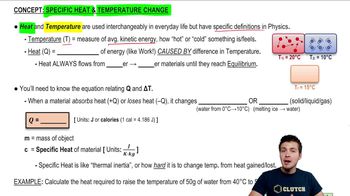
Determine the formula for heat energy required to raise the temperature of an object: Q = mcΔT, where Q is the heat energy, m is the mass of the object, c is the specific heat capacity of the material, and ΔT is the change in temperature.
Calculate the volume of the copper sphere using the formula for the volume of a sphere: V = 43πr3, where r is the radius of the sphere. The radius is half the diameter, so r = 6.02 = 3.0 cm.
Find the mass of the copper sphere using the formula m = ρV, where ρ is the density of copper (approximately 8.96 g/cm³). Substitute the volume calculated in the previous step.
Determine the temperature change ΔT = Tfinal - Tinitial. Here, Tfinal = 150°C and Tinitial = -50°C, so ΔT = 150 - (-50).
Substitute the values for mass, specific heat capacity of copper (approximately 0.385 J/g°C), and temperature change into the heat energy formula Q = mcΔT to calculate the total heat energy required.

Verified video answer for a similar problem:

This video solution was recommended by our tutors as helpful for the problem above.
Video duration:
4m
Was this helpful?

Key Concepts

Here are the essential concepts you must grasp in order to answer the question correctly.

Specific Heat Capacity

Specific heat capacity is the amount of heat energy required to raise the temperature of a unit mass of a substance by one degree Celsius. For copper, this value is approximately 0.385 J/g°C. Understanding this concept is crucial for calculating the heat energy needed to change the temperature of the copper sphere.
Recommended video:
Guided course
06:50
Specific Heat & Temperature Changes

Heat Energy Calculation

The heat energy (Q) required to change the temperature of an object can be calculated using the formula Q = mcΔT, where m is the mass, c is the specific heat capacity, and ΔT is the change in temperature. This formula allows us to quantify the energy needed based on the material's properties and the desired temperature change.
Recommended video:
Guided course
07:27
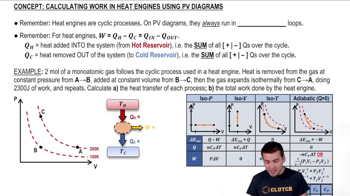
Calculating Work in Heat Engines Using PV Diagrams

Mass of the Sphere

To apply the heat energy calculation, we need to determine the mass of the copper sphere. The mass can be calculated using the formula m = ρV, where ρ is the density of copper (approximately 8.96 g/cm³) and V is the volume of the sphere. The volume of a sphere is given by V = (4/3)πr³, where r is the radius. This step is essential for finding the total heat energy required.
Recommended video:
Guided course
20:32
Mass Spectrometers