Ch 32: AC Circuits
Knight Calc - Physics for Scientists and Engineers 5th Edition
Knight Calc5th EditionPhysics for Scientists and EngineersISBN: 9780137344796Not the one you use?Change textbook
Chapter 32, Problem 7a

A 0.30 μF capacitor is connected across an AC generator that produces a peak voltage of 10 V. What is the peak current to and from the capacitor if the emf frequency is 100 Hz?

Verified step by step guidance
1
Step 1: Understand the relationship between the peak current and the peak voltage in an AC circuit with a capacitor. The peak current (I₀) is given by the formula: I0=V0Xc-1, where V0 is the peak voltage and Xc is the capacitive reactance.
Step 2: Recall the formula for capacitive reactance, Xc=(2πfC)-1, where f is the frequency of the AC generator and C is the capacitance of the capacitor.
Step 3: Substitute the given values into the formula for Xc. The capacitance is 0.30μF (microfarads), which is equivalent to 0.30×10⁻⁶F. The frequency is 100Hz. Plug these values into the formula: Xc=(2π100×0.30×10-6)-1.
Step 4: Once Xc is calculated, use the formula for peak current: I0=V0÷Xc. Substitute the peak voltage V0=10V and the calculated value of Xc into this formula.
Step 5: Simplify the expression to find the peak current I0. This will give the peak current to and from the capacitor at the given frequency.

Verified video answer for a similar problem:

This video solution was recommended by our tutors as helpful for the problem above.
Was this helpful?

Key Concepts

Here are the essential concepts you must grasp in order to answer the question correctly.

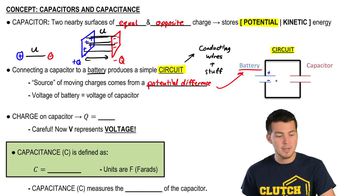
Capacitance

Capacitance is the ability of a capacitor to store electrical charge per unit voltage. It is measured in farads (F) and is defined as the ratio of the charge (Q) stored on one plate of the capacitor to the voltage (V) across the plates. In this question, the capacitor has a capacitance of 0.30 μF, which indicates how much charge it can store when connected to an AC voltage.
Recommended video:
Guided course
08:02
Capacitors & Capacitance (Intro)

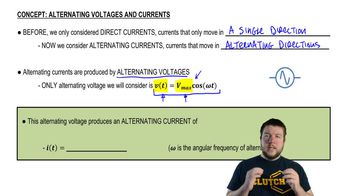
AC Voltage and Frequency

Alternating current (AC) voltage varies sinusoidally with time, characterized by its peak voltage and frequency. The frequency, measured in hertz (Hz), indicates how many cycles occur per second. In this case, the AC generator produces a peak voltage of 10 V at a frequency of 100 Hz, which is essential for calculating the current through the capacitor.
Recommended video:
Guided course
07:49
Alternating Voltages and Currents

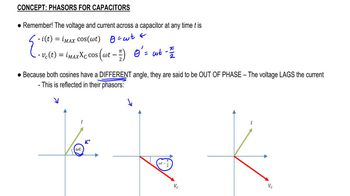
Peak Current in a Capacitor

The peak current (I_peak) through a capacitor in an AC circuit can be calculated using the formula I_peak = C * (dV/dt), where C is the capacitance and dV/dt is the rate of change of voltage. For a sinusoidal voltage, this can be simplified to I_peak = C * ω * V_peak, where ω (omega) is the angular frequency (2πf). This relationship shows how the current depends on both the capacitance and the frequency of the AC source.
Recommended video:
Guided course
04:32
Phasors for Capacitors