Ch 32: AC Circuits
Knight Calc - Physics for Scientists and Engineers 5th Edition
Knight Calc5th EditionPhysics for Scientists and EngineersISBN: 9780137344796Not the one you use?Change textbook
Chapter 32, Problem 1b

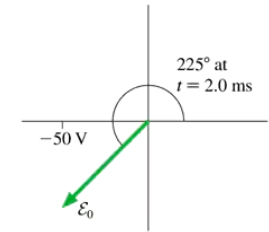
The emf phasor in FIGURE EX32.1 is shown at t = 2.0 ms. What is the peak value of the emf?

Verified step by step guidance
1
Step 1: Understand the problem. The goal is to find the peak value of the emf (ε₀) based on the given phasor diagram. The phasor represents the instantaneous value of the emf at t = 2.0 ms, and the diagram shows the magnitude and direction of the phasor.
Step 2: Analyze the diagram. The phasor is pointing at an angle of 225° and has a projection of -50 V on the vertical axis. This projection represents the instantaneous value of the emf at t = 2.0 ms.
Step 3: Recall the relationship between the instantaneous emf and the peak emf. The instantaneous emf is given by ε(t) = ε₀ * sin(ωt + φ), where ε₀ is the peak emf, ω is the angular frequency, t is the time, and φ is the phase angle. The projection of the phasor on the vertical axis corresponds to ε(t).
Step 4: Use the trigonometric relationship. At t = 2.0 ms, the angle of the phasor is 225°. The sine of this angle determines the ratio between the instantaneous emf (-50 V) and the peak emf (ε₀). Specifically, ε(t) = ε₀ * sin(225°).
Step 5: Solve for ε₀. Rearrange the equation to find ε₀ = ε(t) / sin(225°). Substitute ε(t) = -50 V and calculate sin(225°), which is a known trigonometric value (-√2/2). This will give the peak emf ε₀.

Verified video answer for a similar problem:

This video solution was recommended by our tutors as helpful for the problem above.
Was this helpful?

Key Concepts

Here are the essential concepts you must grasp in order to answer the question correctly.

Electromotive Force (emf)

Electromotive force (emf) is a measure of the energy provided by a source of electrical energy per unit charge. It is often represented as a voltage and can be thought of as the potential difference that drives current in a circuit. In alternating current (AC) circuits, emf can vary with time and is often expressed in terms of its peak value and phase angle.
Recommended video:

Phasors

Phasors are a mathematical representation of sinusoidal functions, particularly useful in analyzing AC circuits. They convert time-dependent sinusoidal voltages and currents into a complex number format, simplifying calculations involving phase differences and amplitudes. The angle of the phasor indicates the phase of the waveform, while its length represents the peak value of the voltage or current.
Recommended video:

Peak Value

The peak value of a sinusoidal waveform is the maximum value it reaches during one cycle. In the context of emf, the peak value is crucial for understanding the maximum potential difference that can be generated. It is typically denoted as E0 and is essential for calculating the effective (RMS) value of the voltage, which is used in practical applications.
Recommended video:
Guided course
8:42
Density Values & Conversions