Ch. 17 - Temperature, Thermal Expansion, and the Ideal Gas Law
Giancoli Douglas - Physics for Scientists and Engineers 5th edition
Giancoli Douglas5th editionPhysics for Scientists and EngineersISBN: 9780137488179Not the one you use?Change textbook
Chapter 17, Problem 25

The pendulum in a grandfather clock is made of brass and keeps perfect time at 17°C. How much time is gained or lost in a year if the clock is kept at 26°C? (Assume the frequency dependence on length for a simple pendulum applies; see Chapter 14.)

Verified step by step guidance
1
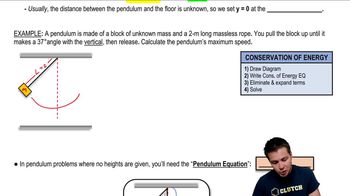
Identify the relationship between the period of a pendulum and its length. The period of a simple pendulum is given by the formula: T=2πlg, where T is the period, l is the length of the pendulum, and g is the acceleration due to gravity.
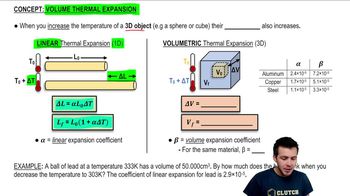
Understand how the length of the pendulum changes with temperature. The length of the pendulum made of brass will expand linearly with temperature according to the formula: l=l_0(1+αT), where l is the new length, l0 is the original length, α is the coefficient of linear expansion for brass, and T is the temperature change.
Determine the fractional change in the period due to the change in length. Since the period depends on the square root of the length, the fractional change in the period is approximately half the fractional change in the length: T12×αT.
Calculate the total time gained or lost in a year. Multiply the fractional change in the period by the total number of seconds in a year: t=(12×αT)×31,536,000, where 31,536,000 is the number of seconds in a year.
Substitute the known values: the coefficient of linear expansion for brass (α19×106), the temperature change (T=26-17), and the total seconds in a year to compute the time gained or lost. Ensure the units are consistent throughout the calculation.

Verified video answer for a similar problem:

This video solution was recommended by our tutors as helpful for the problem above.
Video duration:
7m
Was this helpful?

Key Concepts

Here are the essential concepts you must grasp in order to answer the question correctly.

Thermal Expansion

Thermal expansion refers to the increase in size or volume of materials as they are heated. In the context of the pendulum, the brass will expand when the temperature rises from 17°C to 26°C, affecting its length and, consequently, its oscillation frequency. This change in length alters the time period of the pendulum's swing, which is crucial for understanding how timekeeping is affected by temperature.
Recommended video:
Guided course
05:21
Volume Thermal Expansion

Pendulum Frequency and Length Relationship

The frequency of a simple pendulum is inversely related to the square root of its length. As the length of the pendulum increases due to thermal expansion, the frequency decreases, leading to a longer period of oscillation. This relationship is fundamental in determining how much time is gained or lost by the clock when the temperature changes.
Recommended video:
Guided course
07:17
Pendulum Problems

Time Period of a Pendulum

The time period of a pendulum is the time it takes to complete one full swing back and forth. It is given by the formula T = 2π√(L/g), where L is the length of the pendulum and g is the acceleration due to gravity. Understanding how the time period changes with temperature-induced length variations is essential for calculating the time gained or lost by the clock over a year.
Recommended video:
Guided course
06:28
Satellite Period
Related Practice
Textbook Question

An aluminum bar has the desired length when at 12°C. How much stress is required to keep it at this length if the temperature increases to 38°C? [See Table 12–1.]

1
views

Textbook Question

Determine a formula for the change in surface area of a uniform solid sphere of radius r if its coefficient of linear expansion is α (assumed constant) and its temperature is changed by ∆T.

2
views
Textbook Question

Water’s coefficient of volume expansion in the temperature range from 0°C to about 20°C is given approximately by β = α + bT + cT² , with α = - 6.43 x 10⁻⁵ (C°)⁻¹ , b = 1.70 x 10⁻⁵ (C°)⁻² , and c = -2.02 x 10⁻⁷ ((C°)⁻³. Using the formula for density from Problem 22, show that water has its greatest density at approximately 4.0°C.

1
views
Textbook Question

A horizontal steel I-beam of a cross-sectional area of 0.041 m² is rigidly connected to two fixed vertical supports. If the beam was installed when the temperature was 25°C, is the ultimate strength of the steel exceeded?

1
views
Textbook Question

If a fluid is contained in a long narrow vessel so it can expand in essentially one direction only, show that the effective coefficient of linear expansion α is approximately equal to the coefficient of volume expansion β.

Textbook Question

Wine bottles are never completely filled: a small volume of air is left in the glass bottle’s cylindrically shaped neck (inner diameter d = 18.5 mm) to allow for wine’s fairly large coefficient of thermal expansion. The distance H between the surface of the liquid contents and the bottom of the cork is called the “headspace height” (Fig. 17–22), and is typically H = 1.5 cm for a 750-mL bottle filled at 20°C. Due to its alcoholic content, wine’s coefficient of volume expansion is about double that of water; in comparison, the thermal expansion of glass can be neglected. Estimate H if the bottle is kept at 10°C.

2
views