Ch 25: The Electric Potential
Knight Calc - Physics for Scientists and Engineers 5th Edition
Knight Calc5th EditionPhysics for Scientists and EngineersISBN: 9780137344796Not the one you use?Change textbook
Chapter 25, Problem 5

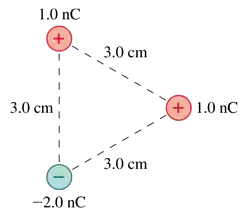
What is the electric potential energy of the group of charges in FIGURE EX25.5?
Diagram of three charges: two positive 1.0 nC charges and one negative 2.0 nC charge, arranged in a triangle with 3 cm sides.

Verified step by step guidance
1
Step 1: Understand the concept of electric potential energy. The electric potential energy of a system of charges is calculated using the formula: U = k * (q1 * q2) / r, where k is Coulomb's constant (8.99 × 10^9 N·m²/C²), q1 and q2 are the charges, and r is the distance between them.
Step 2: Identify the charges and distances in the figure. The charges are: +1.0 nC, +1.0 nC, and -2.0 nC. The distances between the charges are all 3.0 cm (0.03 m).
Step 3: Calculate the potential energy for each pair of charges. There are three pairs: (1) +1.0 nC and +1.0 nC, (2) +1.0 nC and -2.0 nC, and (3) +1.0 nC and -2.0 nC. Use the formula U = k * (q1 * q2) / r for each pair.
Step 4: Add the potential energies of all pairs to find the total electric potential energy of the system. Since potential energy is scalar, simply sum the values obtained for each pair.
Step 5: Ensure units are consistent throughout the calculation. Convert charges to coulombs (1 nC = 1 × 10^-9 C) and distances to meters (3.0 cm = 0.03 m) before substituting into the formula.

Verified video answer for a similar problem:

This video solution was recommended by our tutors as helpful for the problem above.
Was this helpful?

Key Concepts

Here are the essential concepts you must grasp in order to answer the question correctly.

Electric Potential Energy

Electric potential energy is the energy a charged particle possesses due to its position in an electric field. It is calculated based on the interaction between charges, where like charges repel and opposite charges attract. The formula for potential energy between two point charges is given by U = k * (q1 * q2) / r, where k is Coulomb's constant, q1 and q2 are the magnitudes of the charges, and r is the distance between them.
Recommended video:
Guided course
07:51
Electric Potential Energy

Coulomb's Law

Coulomb's Law describes the force between two point charges. It states that the magnitude of the electrostatic force F between two charges is directly proportional to the product of the magnitudes of the charges and inversely proportional to the square of the distance between them. This law is fundamental in calculating the forces acting on the charges in the given configuration, which is essential for determining the total electric potential energy.
Recommended video:
Guided course
09:52
Coulomb's Law

Superposition Principle

The superposition principle in electrostatics states that the total electric potential energy of a system of charges is the sum of the potential energies of each pair of charges. This means that when calculating the potential energy for multiple charges, one can consider the interactions between each pair separately and then add them together. This principle simplifies the analysis of complex charge arrangements, such as the one presented in the question.
Recommended video:
Guided course
03:32
Superposition of Sinusoidal Wave Functions