Ch 25: The Electric Potential
Knight Calc - Physics for Scientists and Engineers 5th Edition
Knight Calc5th EditionPhysics for Scientists and EngineersISBN: 9780137344796Not the one you use?Change textbook
Chapter 25, Problem 10a

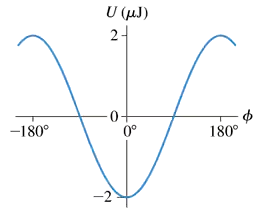
FIGURE EX25.10 shows the potential energy of an electric dipole. Consider a dipole that oscillates between ±60°. What is the dipole's mechanical energy?
Graph showing the potential energy of an electric dipole as a function of angle, oscillating between ±60°.

Verified step by step guidance
1
Step 1: Understand the problem. The mechanical energy of the dipole is the sum of its potential energy and kinetic energy. Since the dipole oscillates between ±60°, its mechanical energy corresponds to the maximum potential energy at these angles.
Step 2: Analyze the graph. The graph shows the potential energy U (in μJ) as a function of the angle φ (in degrees). At ±60°, locate the corresponding potential energy value on the graph. This will be the maximum potential energy of the dipole during its oscillation.
Step 3: Recall that mechanical energy is conserved in oscillatory motion. The mechanical energy remains constant and is equal to the maximum potential energy when the dipole is at its turning points (±60°).
Step 4: Use the graph to determine the potential energy at ±60°. From the graph, visually identify the value of U at φ = ±60°. This value represents the mechanical energy of the dipole.
Step 5: Conclude that the mechanical energy of the dipole is equal to the potential energy at ±60°, as there is no kinetic energy at the turning points. Use the graph to confirm the numerical value of U at these angles.

Verified video answer for a similar problem:

This video solution was recommended by our tutors as helpful for the problem above.
Was this helpful?

Key Concepts

Here are the essential concepts you must grasp in order to answer the question correctly.

Electric Dipole

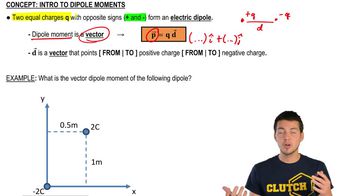
An electric dipole consists of two equal and opposite charges separated by a distance. It creates an electric field and experiences a torque when placed in an external electric field. The orientation of the dipole relative to the field affects its potential energy, which is minimized when aligned with the field.
Recommended video:
Guided course
03:08
Intro To Dipole Moment

Potential Energy of a Dipole

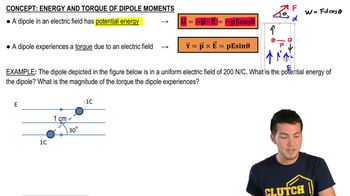
The potential energy (U) of an electric dipole in an electric field is given by the equation U = -p·E·cos(θ), where p is the dipole moment, E is the electric field strength, and θ is the angle between the dipole moment and the field. This energy varies with the angle, reaching a maximum when the dipole is perpendicular to the field and a minimum when aligned with it.
Recommended video:
Guided course
05:19
Energy & Torque of Dipole Moments

Mechanical Energy in Oscillations

Mechanical energy in oscillating systems, such as a dipole oscillating between ±60°, is the sum of kinetic and potential energy. As the dipole moves, its potential energy changes while kinetic energy varies inversely. The total mechanical energy remains constant if no external work is done, allowing the dipole to oscillate between its maximum and minimum potential energy states.
Recommended video:
Guided course
06:24
Conservation Of Mechanical Energy