Ch 25: The Electric Potential
Knight Calc - Physics for Scientists and Engineers 5th Edition
Knight Calc5th EditionPhysics for Scientists and EngineersISBN: 9780137344796Not the one you use?Change textbook
Chapter 25, Problem 1

The electric field strength is 50,000 N/C inside a parallel-plate capacitor with a 2.0 mm spacing. A proton is released from rest at the positive plate. What is the proton's speed when it reaches the negative plate?

Verified step by step guidance
1
Identify the key variables: The electric field strength \( E = 50,000 \, \text{N/C} \), the distance between the plates \( d = 2.0 \times 10^{-3} \; \text{m} \), and the charge and mass of the proton \( q = 1.6 \times 10^{-19} \; \text{C} \) and \( m = 1.67 \times 10^{-27} \; \text{kg} \), respectively.
Calculate the potential difference \( V \) between the plates using the relationship \( V = E \cdot d \). Substitute the given values for \( E \) and \( d \) to find \( V \).
Determine the kinetic energy of the proton when it reaches the negative plate. The work done on the proton by the electric field is equal to the change in its kinetic energy. Use the formula \( W = q \cdot V \), where \( W \) is the work done, \( q \) is the charge of the proton, and \( V \) is the potential difference.
Relate the work done to the proton's kinetic energy using \( W = \frac{1}{2} m v^2 \), where \( m \) is the mass of the proton and \( v \) is its final speed. Solve for \( v \) by rearranging the equation: \( v = \sqrt{\frac{2 W}{m}} \).
Substitute the expression for \( W \) (from step 3) into the equation for \( v \) and calculate \( v \) using the known values of \( q \), \( V \), and \( m \). This will give the proton's speed when it reaches the negative plate.

Verified video answer for a similar problem:

This video solution was recommended by our tutors as helpful for the problem above.
Was this helpful?

Key Concepts

Here are the essential concepts you must grasp in order to answer the question correctly.

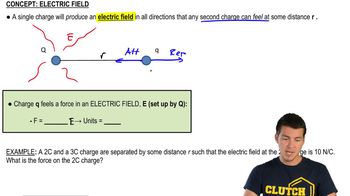
Electric Field

An electric field is a region around a charged object where other charged objects experience a force. The strength of the electric field (E) is defined as the force (F) per unit charge (q), measured in newtons per coulomb (N/C). In this scenario, the electric field strength of 50,000 N/C indicates the force acting on a proton as it moves between the plates of the capacitor.
Recommended video:
Guided course
03:16
Intro to Electric Fields

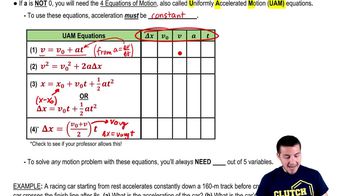
Kinematics of Charged Particles

When a charged particle, such as a proton, moves in an electric field, it experiences acceleration due to the force exerted by the field. The kinematic equations can be used to determine the final speed of the particle as it travels a certain distance. In this case, the distance between the plates and the initial conditions (starting from rest) are crucial for calculating the proton's final speed.
Recommended video:
Guided course
08:25
Kinematics Equations

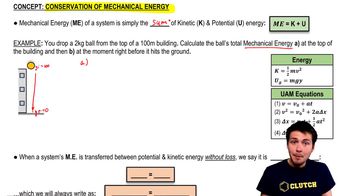
Energy Conservation

The principle of energy conservation states that energy cannot be created or destroyed, only transformed from one form to another. In the context of the capacitor, the electric potential energy of the proton is converted into kinetic energy as it accelerates towards the negative plate. This relationship can be expressed mathematically, allowing for the calculation of the proton's speed based on the electric field and distance traveled.
Recommended video:
Guided course
06:24
Conservation Of Mechanical Energy