Ch 25: The Electric Potential
Knight Calc - Physics for Scientists and Engineers 5th Edition
Knight Calc5th EditionPhysics for Scientists and EngineersISBN: 9780137344796Not the one you use?Change textbook
Chapter 25, Problem 83

A hollow cylindrical shell of length L and radius R has charge Q uniformly distributed along its length. What is the electric potential at the center of the cylinder?

Verified step by step guidance
1
Step 1: Recognize that the electric potential at a point is the sum of contributions from all charge elements. For this problem, the charge is uniformly distributed along the length of the cylindrical shell, so we need to integrate over the length of the cylinder to find the total potential.
Step 2: Write the expression for the electric potential due to a small charge element dq at a distance r from the center. The formula for the electric potential is \( V = \frac{1}{4 \pi \epsilon_0} \frac{dq}{r} \), where \( \epsilon_0 \) is the permittivity of free space.
Step 3: Express dq in terms of the linear charge density \( \lambda \), where \( \lambda = \frac{Q}{L} \). Since the charge is uniformly distributed, \( dq = \lambda dx \), where dx is a small segment of the cylinder's length.
Step 4: Set up the integral to calculate the total potential at the center of the cylinder. The distance from any charge element on the shell to the center is equal to the radius R of the cylinder. Substitute \( dq = \lambda dx \) and \( r = R \) into the potential formula: \( V = \int_{0}^{L} \frac{1}{4 \pi \epsilon_0} \frac{\lambda dx}{R} \).
Step 5: Simplify the integral. Since \( \lambda \), \( R \), and \( \frac{1}{4 \pi \epsilon_0} \) are constants, they can be factored out of the integral. The integral becomes \( V = \frac{\lambda}{4 \pi \epsilon_0 R} \int_{0}^{L} dx \). Evaluate the integral \( \int_{0}^{L} dx \), which equals L, and substitute \( \lambda = \frac{Q}{L} \) to express the final formula for the electric potential.

Verified video answer for a similar problem:

This video solution was recommended by our tutors as helpful for the problem above.
Video duration:
9m
Was this helpful?

Key Concepts

Here are the essential concepts you must grasp in order to answer the question correctly.

Electric Potential

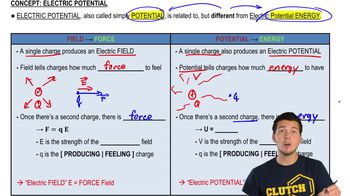
Electric potential is the amount of electric potential energy per unit charge at a point in an electric field. It indicates how much work would be done to move a charge from a reference point to a specific point in the field without any acceleration. Understanding electric potential is crucial for solving problems involving charged objects, as it helps determine the energy landscape created by the charges.
Recommended video:
Guided course
07:33
Electric Potential

Cylindrical Symmetry

Cylindrical symmetry refers to a situation where the physical properties of a system are invariant under rotations around a central axis. In the case of a hollow cylindrical shell, this symmetry simplifies the calculation of electric fields and potentials, as the contributions from different parts of the cylinder can be integrated more easily due to their uniform distribution along the length.
Recommended video:
Guided course
12:39
Solving Symmetric Launch Problems

Gauss's Law

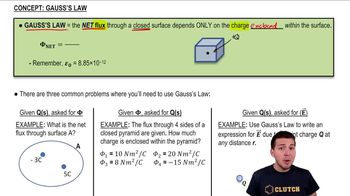
Gauss's Law states that the electric flux through a closed surface is proportional to the enclosed electric charge. This law is particularly useful for calculating electric fields in systems with high symmetry, such as cylindrical shells. By applying Gauss's Law, one can derive the electric field at various points around the cylinder, which is essential for determining the electric potential at the center.
Recommended video: