Textbook Question
Bill can throw a ball vertically at a speed 1.5 times faster than Joe can. How many times higher will Bill's ball go than Joe's?
1
views

 Giancoli Douglas 5th editionCh. 02 - Describing Motion: Kinematics in One DimensionProblem 97a
 Verified step by step guidance
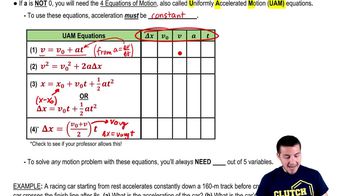
 08:25
08:25
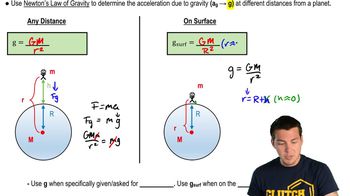 05:20
05:20 07:32
07:32Bill can throw a ball vertically at a speed 1.5 times faster than Joe can. How many times higher will Bill's ball go than Joe's?
A robot used in a pharmacy picks up a medicine bottle at t = 0. It accelerates at 0.20 m/s² for 4.5 s, then travels without acceleration for 68 s and finally decelerates at ―0.40 m/s² for 2.5 s to reach the counter where the pharmacist will take the medicine from the robot. From how far away did the robot fetch the medicine?
A police car at rest is passed by a speeder traveling at a constant 140 km/h. The police officer takes off in hot pursuit and catches up to the speeder in 850 m, maintaining a constant acceleration. Qualitatively plot the position vs. time graph for both cars from the police car's start to the catch-up point.
Figure 2–55 shows the position vs. time graph for two bicycles, A and B. At which instant(s) are the bicycles passing each other? Which bicycle is passing the other?
Two children are playing on two trampolines. The first child bounces up one-and-a-half times higher than the second child. The initial speed upwards of the second child is 4.0 m/s. What is the initial speed of the first child?
Suppose a 65-kg person jumps from a height of 3.0 m down to the ground. What is the speed of the person just before landing (Chapter 2)?
<IMAGE>