
Ch 30: Electromagnetic Induction
Knight Calc - Physics for Scientists and Engineers 5th Edition
Knight Calc5th EditionPhysics for Scientists and EngineersISBN: 9780137344796Not the one you use?Change textbook
Chapter 30, Problem 69b

A 50 cm solenoid with 1000 turns has an inductance of 20 mH. Flipping a switch disconnects the inductor from the battery and connects it to a resistor. What is the value of the resistance if the magnetic field decreases by 50% in 150 μs?

Verified step by step guidance
1
Step 1: Understand the problem. The solenoid is disconnected from the battery and connected to a resistor, causing the magnetic field to decrease. The problem involves calculating the resistance using the time constant of the RL circuit. The time constant (τ) is related to the inductance (L) and resistance (R) by the formula: τ=LR.
Step 2: Recall the relationship between the time constant and the decay of the magnetic field. The magnetic field decreases exponentially in an RL circuit, following the equation: B=B0e^-tτ, where B0 is the initial magnetic field, B is the magnetic field at time t, and τ is the time constant.
Step 3: Use the given information to find the time constant. The magnetic field decreases by 50% in 150 μs, meaning B=12B0 at t=150×10^-6s. Substitute this into the exponential decay formula and solve for τ: 12=e^-150τ. Take the natural logarithm of both sides to isolate τ.
Step 4: Relate the time constant to the resistance. Once τ is calculated, use the formula τ=LR to solve for R. The inductance L is given as 20 mH, or 20×10^-3H. Rearrange the formula to find R=Lτ.
Step 5: Substitute the values into the formula. Use the calculated value of τ and the given inductance L to find the resistance R. Ensure the units are consistent throughout the calculation.

Verified video answer for a similar problem:

This video solution was recommended by our tutors as helpful for the problem above.
Video duration:
8m
Was this helpful?

Key Concepts

Here are the essential concepts you must grasp in order to answer the question correctly.

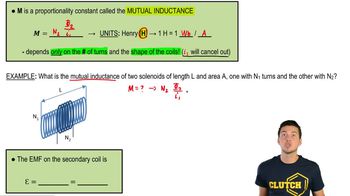
Inductance

Inductance is a property of an electrical component, typically a coil or solenoid, that quantifies its ability to store energy in a magnetic field when an electric current flows through it. It is measured in henries (H) and is defined as the ratio of the induced electromotive force (emf) to the rate of change of current. In this question, the solenoid's inductance of 20 mH indicates how effectively it can store magnetic energy.
Recommended video:
Guided course
12:59
Mutual Induction

Time Constant

The time constant, denoted by τ (tau), is a measure of the time it takes for the current in an inductor to change significantly when connected to a resistor. It is calculated as τ = L/R, where L is the inductance and R is the resistance. In this scenario, the time constant will help determine how quickly the magnetic field decreases when the inductor is disconnected from the battery and connected to the resistor.
Recommended video:
Guided course
08:59
Phase Constant of a Wave Function

Magnetic Field Decay

When an inductor is disconnected from a power source and connected to a resistor, the magnetic field associated with the inductor begins to decay. The rate of this decay is exponential, characterized by the time constant. In this question, the magnetic field decreases by 50% in 150 μs, which can be used to find the resistance by relating the decay time to the time constant of the circuit.
Recommended video:
Guided course
05:30
Magnetic Fields and Magnetic Dipoles