
Ch 30: Electromagnetic Induction
Knight Calc - Physics for Scientists and Engineers 5th Edition
Knight Calc5th EditionPhysics for Scientists and EngineersISBN: 9780137344796Not the one you use?Change textbook
Chapter 30, Problem 67

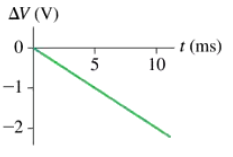
CALC FIGURE P30.67 shows the potential difference across a 20 mH inductor. The current through the inductor at t = 0 ms is 0.25 A. What is the current at t = 10 ms?

Verified step by step guidance
1
Step 1: Recall the relationship between the voltage across an inductor and the rate of change of current. The formula is given by: V = LdIdt, where V is the voltage across the inductor, L is the inductance, and dIdt is the rate of change of current.
Step 2: From the graph, observe that the voltage across the inductor decreases linearly from 0 V at t = 0 ms to -2 V at t = 10 ms. This indicates a constant rate of change of voltage over time. Calculate the slope of the voltage graph to find dVdt.
Step 3: Use the formula V = LdIdt to express dIdt as VL. Substitute the inductance value L = 20 mH (or 0.02 H) and the voltage values from the graph into the equation.
Step 4: Integrate dIdt over the time interval from t = 0 ms to t = 10 ms to find the change in current. The integral is given by: I(t) = I(0) + 1LV(t)dt, where I(0) is the initial current.
Step 5: Perform the integration using the linear voltage function from the graph, V(t) = -0.2t (derived from the slope of the graph). Substitute the limits of integration (t = 0 ms to t = 10 ms) and the initial current I(0) = 0.25 A to find the current at t = 10 ms.

Verified video answer for a similar problem:

This video solution was recommended by our tutors as helpful for the problem above.
Was this helpful?

Key Concepts

Here are the essential concepts you must grasp in order to answer the question correctly.

Inductance

Inductance is a property of an electrical component, typically a coil or inductor, that quantifies its ability to store energy in a magnetic field when an electric current flows through it. The unit of inductance is the henry (H). In this scenario, the inductor has a value of 20 mH, indicating it can store energy based on the current flowing through it and the rate of change of that current.
Recommended video:
Guided course
12:59
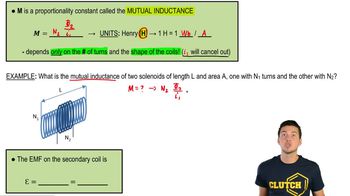
Mutual Induction

Faraday's Law of Electromagnetic Induction

Faraday's Law states that a change in magnetic flux through a circuit induces an electromotive force (EMF) in the circuit. For inductors, this means that the voltage across the inductor is proportional to the rate of change of current through it. The relationship can be expressed as V = L (di/dt), where V is the voltage, L is the inductance, and di/dt is the rate of change of current.
Recommended video:
Guided course
09:26
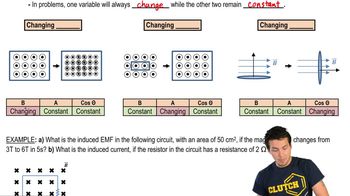
Faraday's Law

Current Decay in an Inductor

In an inductor, the current does not change instantaneously; instead, it decays over time when subjected to a changing voltage. The current at any time can be calculated using the formula I(t) = I0 + (V/L)t, where I0 is the initial current, V is the voltage across the inductor, L is the inductance, and t is time. This concept is crucial for determining the current at t = 10 ms based on the given voltage change.
Recommended video:
Guided course
07:10
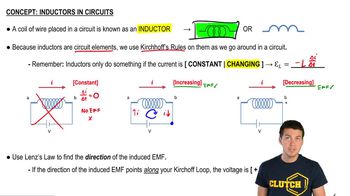
Inductors in Circuits
Related Practice
Textbook Question

BIO One possible concern with MRI (see Exercise 28) is turning the magnetic field on or off too quickly. Bodily fluids are conductors, and a changing magnetic field could cause electric currents to flow through the patient. Suppose a typical patient has a maximum cross-section area of 0.060 m2. What is the smallest time interval in which a 5.0 T magnetic field can be turned on or off if the induced emf around the patient's body must be kept to less than 0.10 V?

Textbook Question

A 50 cm solenoid with 1000 turns has an inductance of 20 mH. What is the magnetic field strength inside the inductor when the current is 75 mA?

1
views
Textbook Question

INT FIGURE P30.59 shows a U-shaped conducting rail that is oriented vertically in a horizontal magnetic field. The rail has no electric resistance and does not move. A slide wire with mass m and resistance R can slide up and down without friction while maintaining electrical contact with the rail. The slide wire is released from rest. Determine the value of vterm if l = 20 cm,m = 10 g, R = 0.10 Ω, and B = 0.50 T.

1
views
Textbook Question

A 50 cm solenoid with 1000 turns has an inductance of 20 mH. Flipping a switch disconnects the inductor from the battery and connects it to a resistor. What is the value of the resistance if the magnetic field decreases by 50% in 150 μs?

1
views
Textbook Question

CALC The current through inductance L is given by I=I0et/τI = I_0 e^{-t/\(\tau\)}. Find an expression for the potential difference ΔVL across the inductor.

2
views
Textbook Question

One way to measure the strength of a magnetic field is with a flip coil. Suppose a 200-turn, 4.0-cm-diameter coil with a resistance of 2.0 Ω is connected to a ballistic galvanometer, a device that measures the total charge passing through. The coil is held perpendicular to the field, then quickly flipped 180° so that the opposite side is facing the magnetic field. Afterward, the galvanometer reads 7.5 μC. What is the field strength? Hint: Use I = dq/dt to relate the net change of flux to the amount of charge that flows through the galvanometer.

1
views