

Ch 30: Electromagnetic Induction
Knight Calc - Physics for Scientists and Engineers 5th Edition
Knight Calc5th EditionPhysics for Scientists and EngineersISBN: 9780137344796Not the one you use?Change textbook
Chapter 30, Problem 59b

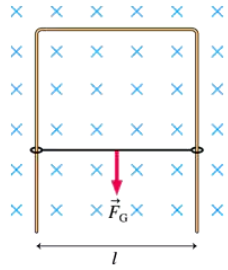
INT FIGURE P30.59 shows a U-shaped conducting rail that is oriented vertically in a horizontal magnetic field. The rail has no electric resistance and does not move. A slide wire with mass m and resistance R can slide up and down without friction while maintaining electrical contact with the rail. The slide wire is released from rest. Determine the value of vterm if l = 20 cm,m = 10 g, R = 0.10 Ω, and B = 0.50 T.

Verified step by step guidance
1
Step 1: Understand the problem setup. The slide wire is moving vertically in a horizontal magnetic field, generating an electromotive force (EMF) due to its motion. This EMF induces a current in the circuit formed by the rail and the wire. The magnetic field exerts a force on the current-carrying wire, opposing its motion. At terminal velocity, the magnetic force balances the gravitational force acting on the wire.
Step 2: Write the expression for the EMF induced in the wire. The EMF (ε) is given by Faraday's law: ε = B * l * v, where B is the magnetic field strength, l is the length of the wire, and v is the velocity of the wire.
Step 3: Determine the current in the circuit. Using Ohm's law, the current (I) in the circuit is given by I = ε / R, where R is the resistance of the wire. Substituting ε = B * l * v, we get I = (B * l * v) / R.
Step 4: Calculate the magnetic force acting on the wire. The magnetic force (F_mag) is given by F_mag = B * l * I. Substituting I = (B * l * v) / R, we get F_mag = (B^2 * l^2 * v) / R.
Step 5: Set up the force balance equation at terminal velocity. At terminal velocity, the magnetic force balances the gravitational force: F_mag = F_gravity. The gravitational force is given by F_gravity = m * g, where m is the mass of the wire and g is the acceleration due to gravity. Equating F_mag and F_gravity, we get (B^2 * l^2 * v_term) / R = m * g. Solve this equation for v_term to find the terminal velocity.

Verified video answer for a similar problem:

This video solution was recommended by our tutors as helpful for the problem above.
Was this helpful?

Key Concepts

Here are the essential concepts you must grasp in order to answer the question correctly.

Electromagnetic Induction

Electromagnetic induction is the process by which a changing magnetic field within a closed loop induces an electromotive force (EMF) in the wire. This principle, described by Faraday's law, states that the induced EMF is proportional to the rate of change of the magnetic flux through the loop. In this scenario, as the slide wire moves through the magnetic field, it experiences a change in magnetic flux, leading to the generation of an induced current.
Recommended video:
Guided course
05:42
Introduction to Induction

Lorentz Force

The Lorentz force is the force experienced by a charged particle moving through a magnetic field. It is given by the equation F = q(v × B), where F is the force, q is the charge, v is the velocity of the particle, and B is the magnetic field. In this case, the current induced in the slide wire creates a magnetic force that acts perpendicular to both the direction of the current and the magnetic field, influencing the motion of the wire.
Recommended video:
Guided course
13:39
Lorentz Transformations of Velocity

Terminal Velocity

Terminal velocity is the constant speed that a freely falling object eventually reaches when the resistance of the medium prevents further acceleration. In this context, the slide wire will reach a terminal velocity when the gravitational force acting on it is balanced by the magnetic force due to the induced current. This balance of forces allows us to calculate the terminal velocity using the mass of the wire, the resistance, and the magnetic field strength.
Recommended video:
Guided course
7:27
Escape Velocity
Related Practice
Textbook Question

BIO One possible concern with MRI (see Exercise 28) is turning the magnetic field on or off too quickly. Bodily fluids are conductors, and a changing magnetic field could cause electric currents to flow through the patient. Suppose a typical patient has a maximum cross-section area of 0.060 m2. What is the smallest time interval in which a 5.0 T magnetic field can be turned on or off if the induced emf around the patient's body must be kept to less than 0.10 V?

Textbook Question

INT You've decided to make the magnetic projectile launcher shown in FIGURE P30.58 for your science project. An aluminum bar slides along metal rails through a magnetic field B. The switch closes at t = 0 s, while the bar is at rest, and a battery of emf εbat starts a current flowing around the loop. The battery has internal resistance r. The resistances of the rails, which are separated by distance l, and the bar are effectively zero. Evaluate vterm for εbat = 1.0 V, r = 0.10 Ω, l = 6.0 cm, and B = 0.50 T.

Textbook Question

CALC FIGURE P30.67 shows the potential difference across a 20 mH inductor. The current through the inductor at t = 0 ms is 0.25 A. What is the current at t = 10 ms?

2
views
Textbook Question

INT You've decided to make the magnetic projectile launcher shown in FIGURE P30.58 for your science project. An aluminum bar slides along metal rails through a magnetic field B. The switch closes at t = 0 s, while the bar is at rest, and a battery of emf εbat starts a current flowing around the loop. The battery has internal resistance r. The resistances of the rails, which are separated by distance l, and the bar are effectively zero. Show that the bar reaches a terminal speed vterm, and find an expression for vterm.

Textbook Question

CALC Your camping buddy has an idea for a light to go inside your tent. He happens to have a powerful (and heavy!) horseshoe magnet that he bought at a surplus store. This magnet creates a 0.20 T field between two pole tips 10 cm apart. His idea is to build the hand-cranked generator shown in FIGURE P30.57. He thinks you can make enough current to fully light a 1.0 Ω lightbulb rated at 4.0 W. That's not super bright, but it should be plenty of light for routine activities in the tent. With what frequency will you have to turn the crank for the maximum current to fully light the bulb? Is this feasible?

Textbook Question

One way to measure the strength of a magnetic field is with a flip coil. Suppose a 200-turn, 4.0-cm-diameter coil with a resistance of 2.0 Ω is connected to a ballistic galvanometer, a device that measures the total charge passing through. The coil is held perpendicular to the field, then quickly flipped 180° so that the opposite side is facing the magnetic field. Afterward, the galvanometer reads 7.5 μC. What is the field strength? Hint: Use I = dq/dt to relate the net change of flux to the amount of charge that flows through the galvanometer.

1
views